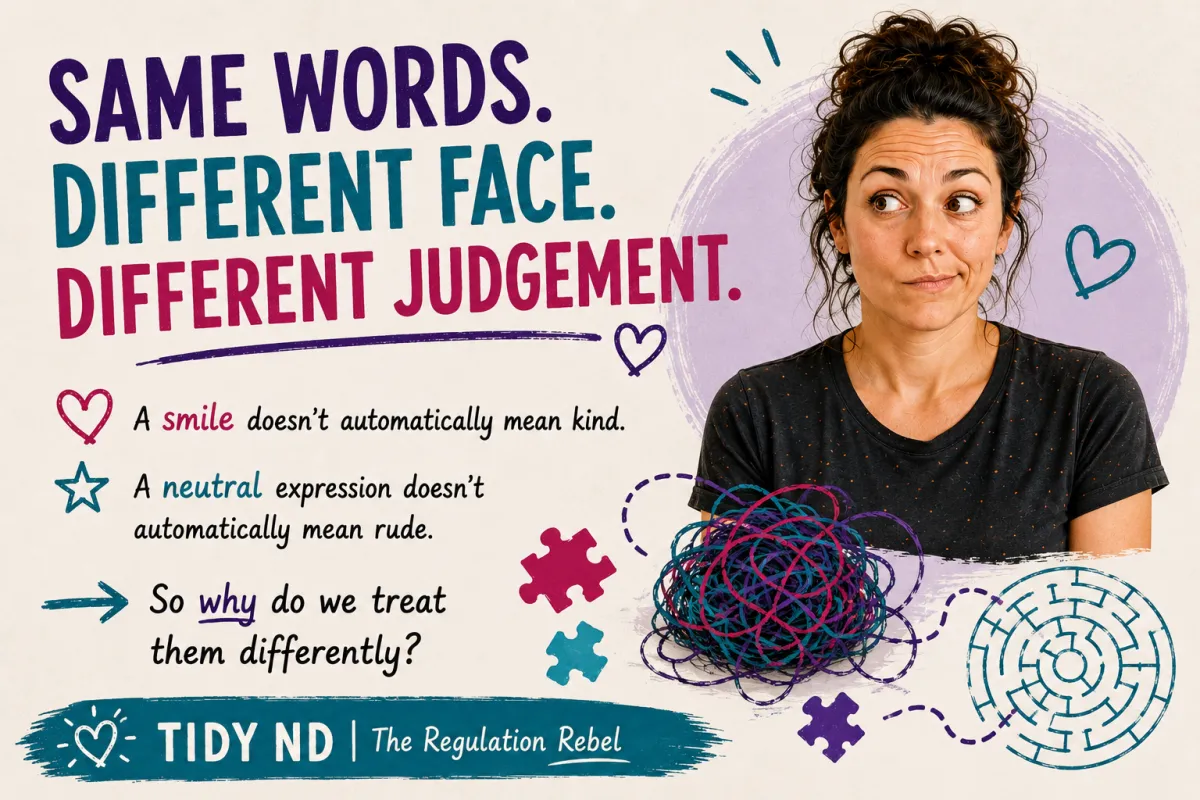
Different Expression, Different Judgement, Same Words
Different Expression, Different Judgement, Same Words
Most of us like to believe that we judge communication based on what is actually said.
But if we're honest, that's rarely how communication works.
The words matter.
Yet they are only one part of the message.
A smile, a frown, a raised eyebrow, crossed arms, a tired face, or a flat tone can completely change how we interpret someone's intent.
And sometimes, the judgement we make has very little to do with the words themselves.
The Experiment We Perform Every Day
Imagine someone asks:
"Can you actually do that properly?"
Now imagine they ask while smiling.
Many people would interpret the comment as teasing, playful, or light-hearted.
Now imagine the exact same sentence delivered with a neutral expression.
Suddenly the assumptions begin.
They're annoyed.
They're being rude.
They're criticising me.
They're angry.
The words haven't changed.
Our interpretation has.
This happens thousands of times every day in homes, schools, workplaces, and relationships.
Why This Happens
Human beings are meaning-making machines.
Our brains are constantly scanning for information about safety, belonging, acceptance, and threat.
Words provide some information.
Facial expressions provide more.
Tone provides more.
Past experiences provide even more.
When we hear someone speak, we are not simply processing language.
We are interpreting context.
Our brains attempt to answer a question before we've even realised we're asking it:
"What does this person mean?"
The challenge is that sometimes our brains get it wrong.
What Most People Miss
Many communication problems are treated as word problems.
People focus on:
What was said
The exact wording
Whether someone should or shouldn't have said it
But communication is often a context problem.
Two people can hear the same sentence and walk away with completely different experiences.
One hears humour.
Another hears criticism.
One hears curiosity.
Another hears judgement.
The difference isn't always the words.
The difference is often the meaning assigned to the words.
The TKC Perspective
At TKC, we often talk about understanding behaviour through context.
Nobody is the problem.
The pattern is the problem.
When communication breaks down, it can be tempting to decide that someone is rude, disrespectful, sensitive, difficult, or overreacting.
But those labels rarely help us understand what is actually happening.
Instead, we can become curious about the pattern.
What assumptions were made?
What cues were being interpreted?
What information was missing?
What experiences might be shaping the response?
The goal isn't to determine who is right.
The goal is to understand what happened.
Because understanding creates options.
Judgement creates conflict.
What This Looks Like With Children
This is especially important when we think about children.
A child may answer with a flat tone and be seen as rude.
A teenager may avoid eye contact and be viewed as disrespectful.
A neurodivergent child may have facial expressions that don't match what others expect.
Adults often assume intent based on presentation.
But presentation and intent are not always the same thing.
A child who appears uninterested may actually be concentrating.
A child who looks angry may actually be overwhelmed.
A child who doesn't smile may simply be tired, anxious, processing information, or regulating their energy.
When we focus only on expression, we risk missing the message.
A Practical Example
Imagine a parent asks their child:
"Did you remember to put your shoes away?"
The child responds:
"No."
If the child has a neutral expression, the parent may assume attitude.
If the child looks frustrated, the parent may assume defiance.
If the child smiles, the same response may seem harmless.
But none of those assumptions tell us what the child actually meant.
The only thing we know for certain is that the answer was no.
Everything else is interpretation.
When we recognise this, we can pause before reacting.
Instead of responding to our assumption, we can seek clarity.
"Can you tell me what happened?"
That simple shift often changes the entire interaction.
Questions Worth Asking
The next time communication feels difficult, try asking:
Am I reacting to the words or to the expression?
What assumptions am I making about intent?
Could there be another explanation?
What context might I be missing?
Have I checked my interpretation before responding?
These questions don't remove conflict.
But they do reduce unnecessary misunderstandings.
The Takeaway
Communication is about more than words.
We are constantly interpreting facial expressions, tone, body language, context, and past experiences.
Sometimes those interpretations help us.
Sometimes they lead us in the wrong direction.
The challenge is not to stop making interpretations altogether.
The challenge is to become aware that we are making them.
Because when we recognise that meaning and intent are not always obvious, we become more curious.
And curiosity often creates understanding.
Different expression.
Different judgement.
Same words.
Find out more here: TKC – The Kid Connection
![The Regulation Rebel [Emma Fisher]](https://assets.cdn.filesafe.space/Zr7YHCDPEnjUowekYk1E/media/6a2e3969c53e51acc0038a32.png)