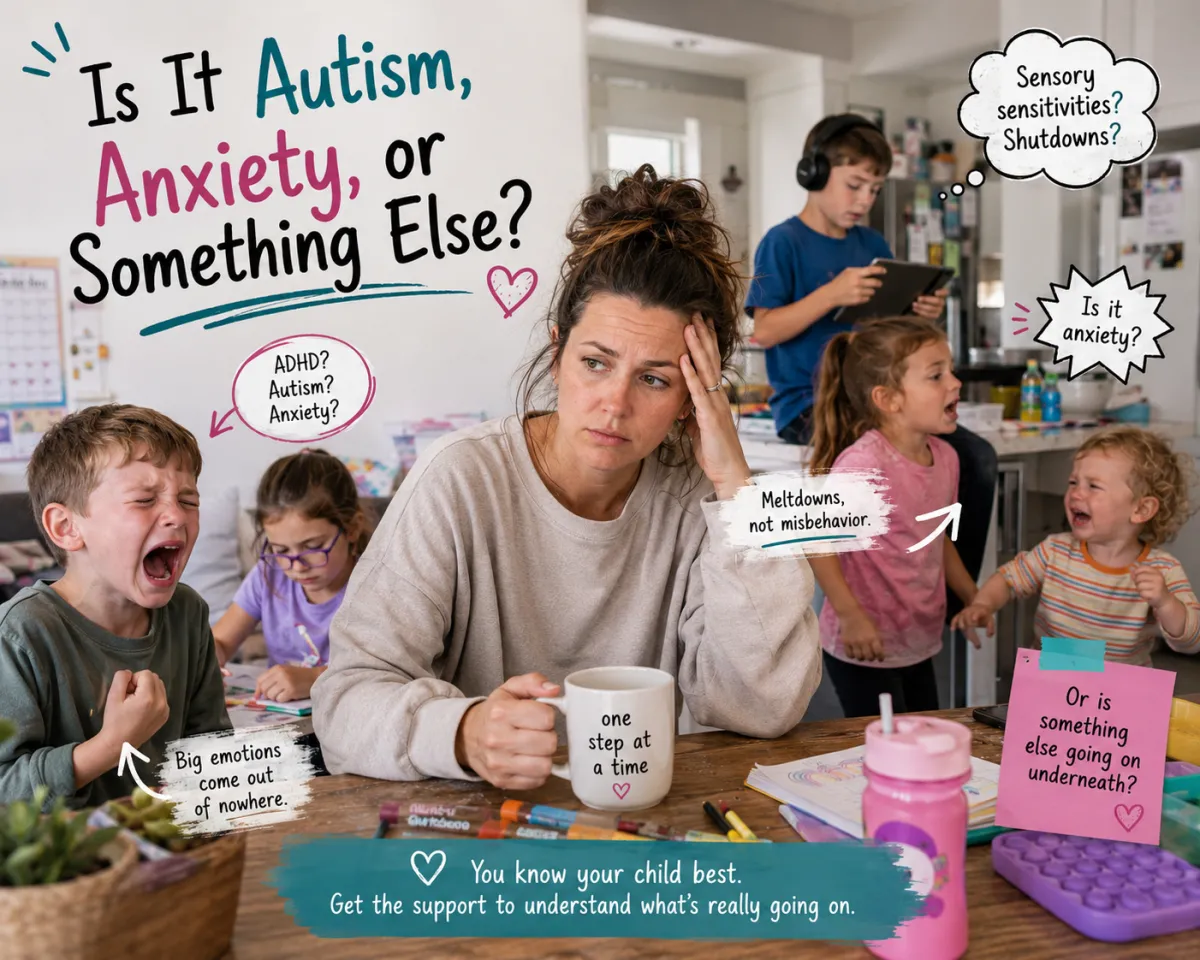
Is It Autism, Anxiety, or Something Else?
Is It Autism, Anxiety, or Something Else?
Many parents find themselves asking this question at some point:
"Is it autism, anxiety, or something else?"
Perhaps your child avoids certain situations.
Maybe they struggle with change.
Maybe they have intense emotional reactions, difficulty attending school, challenges with friendships, or a strong need for predictability.
You notice patterns that feel different from what you expected.
You start searching for answers.
And before long, you're trying to work out which explanation fits best.
This is a very human response.
We look for labels because labels can help us make sense of confusing experiences.
They can guide support, open doors to services, and provide language for what we're seeing.
But there is an important piece that often gets missed.
Understanding the child should come before trying to categorise the child.
Why This Question Is So Common
Many developmental, emotional, sensory, and neurological differences can create behaviours that look similar from the outside.
For example, a child may:
Avoid social situations
Refuse school
Become distressed by change
Need significant reassurance
Experience meltdowns
Withdraw from activities
Appear rigid or inflexible
Struggle in busy environments
These behaviours can sometimes be associated with autism.
They can also be associated with anxiety.
They can also be connected to sensory processing challenges, communication differences, learning difficulties, trauma, exhaustion, executive functioning challenges, or a combination of factors.
This is one reason why behaviour alone rarely tells the whole story.
Why Surface Behaviour Can Be Misleading
Imagine two children who both refuse to attend a birthday party.
From the outside, their behaviour appears identical.
Both say no.
Both become distressed.
Both resist leaving home.
Yet their experiences may be completely different.
One child may be worried about social interactions.
Another may be overwhelmed by noise, unpredictability, and sensory input.
The behaviour is the same.
The underlying experience is not.
When we focus only on what we can see, it's easy to miss the reasons underneath.
What Most People Miss
Many conversations begin with:
"What is wrong?"
But this question often sends us searching for problems rather than understanding.
A more useful question can be:
"What is this child experiencing?"
This subtle shift changes everything.
Instead of trying to fit a child into a category immediately, we become curious about their lived experience.
We start gathering information.
We notice patterns.
We explore context.
And we begin to understand what may be driving the behaviour.
The TKC Perspective
At TKC, we encourage parents to become pattern observers.
Rather than focusing only on labels, we focus on understanding.
That doesn't mean diagnoses aren't important.
For many families, diagnoses provide clarity, validation, and access to support.
But regardless of diagnosis, understanding the individual child remains essential.
Two autistic children may have very different needs.
Two anxious children may have very different experiences.
Even children with the same diagnosis can require completely different approaches.
That's why understanding always matters.
The goal is not simply identifying what something is called.
The goal is understanding what support is needed.
Looking for Clues in Context
When you're trying to understand a pattern, context often provides valuable information.
Consider questions such as:
When does the difficulty occur?
Is it happening everywhere?
Or only in certain situations?
What seems to make things harder?
Are there sensory demands?
Social demands?
Unexpected changes?
Performance expectations?
What seems to help?
Do certain environments reduce the challenge?
Does predictability help?
Does extra preparation make a difference?
What happens before the behaviour?
The events leading up to a behaviour often tell us more than the behaviour itself.
Patterns frequently leave clues.
A Practical Example
Imagine a child who regularly becomes distressed before school.
At first glance, anxiety may seem like the obvious explanation.
And anxiety may indeed be part of the picture.
But further observation reveals additional details.
The child struggles most on days involving assemblies.
They become distressed in noisy environments.
They cover their ears during lunch breaks.
They seem exhausted after highly stimulating days.
Now the picture becomes more complex.
The distress may involve anxiety.
It may also involve sensory overwhelm.
One challenge may be contributing to the other.
Without understanding the broader context, important pieces of the puzzle remain hidden.
The Importance of Avoiding Quick Conclusions
When we're worried about our children, it's natural to want certainty.
We want a clear answer.
We want a clear plan.
We want reassurance that we're heading in the right direction.
But quick conclusions sometimes create blind spots.
When we decide too early that we know exactly what's happening, we may stop looking for other possibilities.
Curiosity keeps us open to learning.
And learning often leads to better support.
Reflection Questions
If you're asking yourself whether it's autism, anxiety, or something else, consider these questions:
What patterns am I noticing?
When do these patterns appear?
When do they not appear?
What environmental factors might be contributing?
What seems difficult for my child?
What seems to help?
What experience might exist underneath the behaviour?
These questions won't provide an instant diagnosis.
But they can provide valuable understanding.
Summary
When parents ask, "Is it autism, anxiety, or something else?", they're usually trying to understand a child whose behaviour doesn't fully make sense yet.
The challenge is that many different experiences can create similar behaviours.
That's why behaviour alone rarely gives us the full answer.
Context matters.
Patterns matter.
Understanding matters.
Whether the eventual answer involves autism, anxiety, another explanation, or a combination of factors, the most useful starting point is often the same:
Become curious about the experience underneath the behaviour.
Because the goal isn't simply finding a label.
The goal is understanding the child well enough to provide the support they need.
And that understanding begins with observation, curiosity, and a willingness to look beneath the surface.