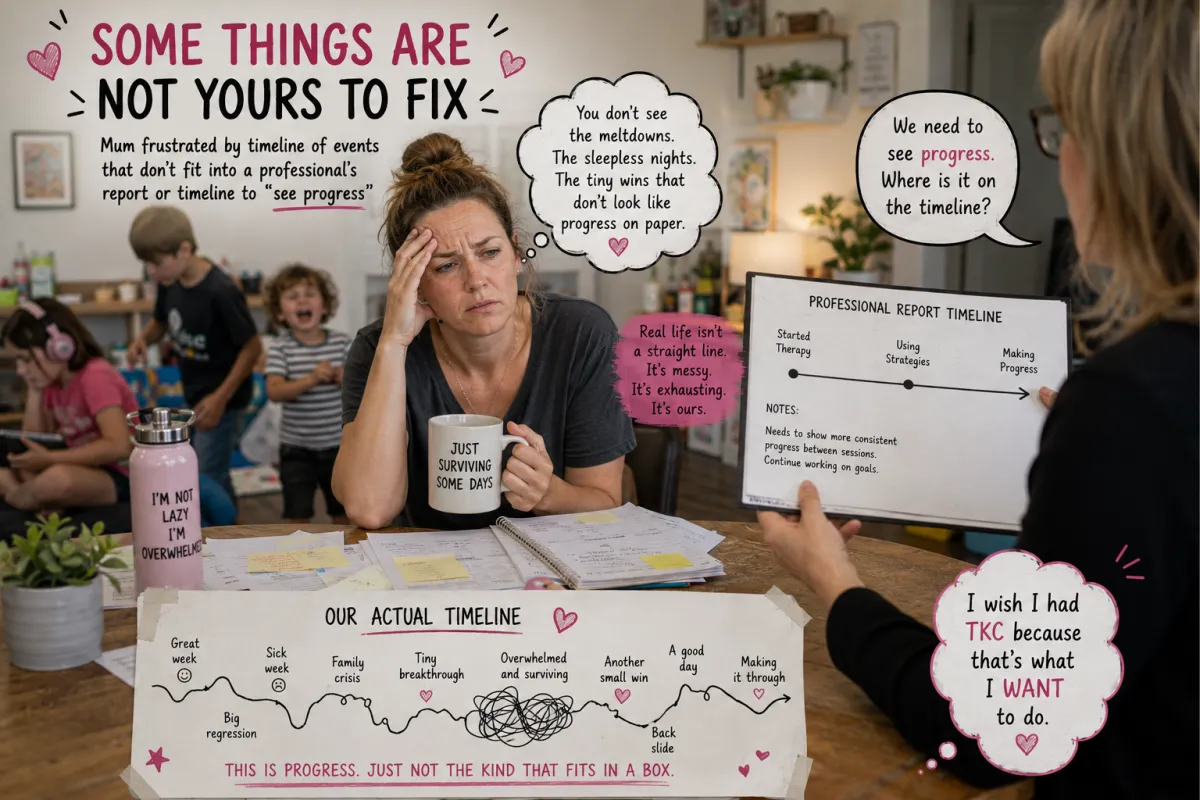
It's Not Yours To Fix
Some Things Are Not Yours To Fix
One of the most exhausting beliefs parents carry is this:
If I can just find the right strategy, I can solve this.
The right script.
The right consequence.
The right regulation technique.
The right therapist.
The right parenting framework.
And while support matters, there are some things that no parenting strategy can solve.
Not because you're failing.
Because they were never yours to fix in the first place.
Life is guaranteed to change.
And with change, a whole list of new problems.
Problems that we haven't encountered before.
And something we have never solved before.
But here is the kicker,
You Can't Solve A Child's Grief or Uncomfortable Feelings
You can sit beside their feelings.
You can witness it.
Grow with it.
You can create safety around it.
But you cannot remove it.
If a child is grieving a parent, a relationship, a family change, a loss, or the life they thought they would have, no perfectly delivered parenting response makes that grief disappear.
There are going to be hard times. Always.
The goal isn't to eliminate grief or the uncomfortable feelings.
The goal is to help them move through it.
You Can't Trauma-Process For Someone Else
You can provide support.
You can reduce current threats.
You can help create opportunities for healing.
But healing cannot be forced.
And it can take a long time.
Trauma doesn't resolve because somebody else wants it to.
It comes through moving through the emotion
And processing all those feelings slowly.
And it certainly doesn't resolve according to a timeline that feels convenient for the adults involved or reporting that needs to happen.
You Can't Remove Loyalty Conflicts
When children feel caught between people they love, there is often no perfect answer.
No perfect script.
No magical phrase that makes the conflict disappear.
A child can love two people who are struggling with each other.
A child can feel torn.
A child can carry impossible emotions.
Your job is not to erase the conflict.
Your job is to help them survive it.
You Can't Create Developmental Readiness Before It Exists
Many parents are trying to teach skills their child's nervous system cannot access yet.
And then they try and fast-pace the process by doing somatic training.
And it's not because the child is refusing.
Because readiness hasn't arrived.
The body hasn't integrated.
The nervous system is developing through experience.
We cannot force a seed to become a tree through effort.
Development unfolds when development unfolds.
Support helps.
Understanding helps.
Relational and co-regulating help.
Pressure rarely does.
You Can't Fast-Track Emotional Maturity
Children borrow our regulation long before they can consistently create their own.
That isn't failure.
That's development.
Many of the capacities adults expect from children are skills that take years to build.
Perspective.
Impulse control.
Emotional flexibility.
Frustration tolerance.
Self-reflection.
These are developmental achievements, not compliance tasks.
Half the adult population doesn't contain the skills.
And most of them don't have the knowledge, skills or insight to achieve it.
What a LOT of pressure to put on a child! (Even a brilliant one like yours)
And You Can't Regulate Another Person's Nervous System
This may be the hardest one for us parents.
You can influence.
You can support.
You can co-regulate.
You can create safety.
But ultimately, another person's nervous system belongs to them.
Not to you.
Not even when you love them deeply.
Many parent-carers spend years carrying responsibility for emotional states they cannot actually control.
Trying harder.
Giving more.
Monitoring constantly.
Searching for the thing they missed.
The thing they should have done differently.
The thing that would finally make everyone okay.
But some experiences are bigger than your influence.
And recognising that isn't giving up.
It's stepping out of an impossible job description.
What is bigger than all your efforts to problem solve?
Your relationship with them - by far.
The Real Work
The real work is often not fixing.
It's holding.
Holding space for grief.
Holding space for big feelings.
Holding safety during healing.
Holding connection through conflict.
Holding realistic expectations around development.
Holding compassion for yourself when another person's emotions remain unresolved.
Giving grace to them in difficult times.
Giving grace to yourself in the process.
Because it IS hard.
Because sometimes the most important shift isn't learning how to fix what's happening.
It's understanding what was never yours to carry alone.
And yet you are the biggest resource your child has.
Not sure where to start?
Join my email list