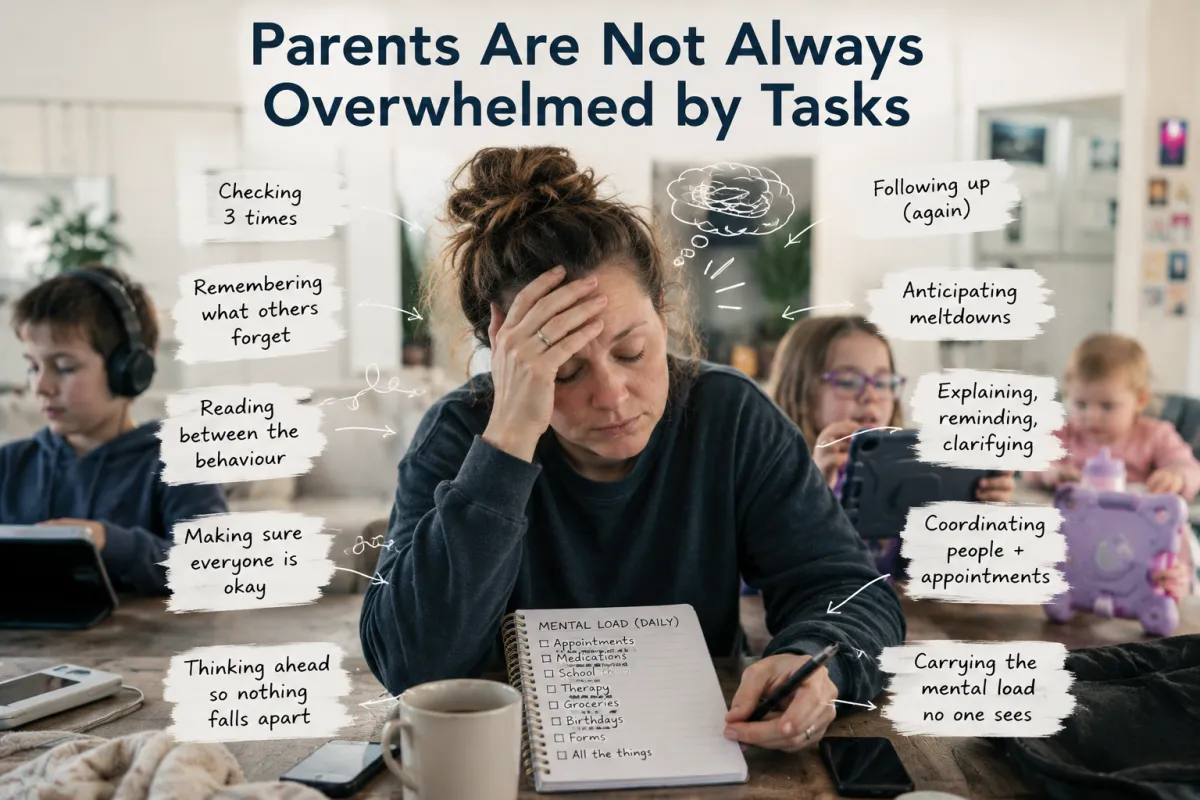
Parents Are Not Always Overwhelmed by Tasks
Parents Are Not Always Overwhelmed by Tasks
When we talk about parental overwhelm, the conversation usually focuses on workload.
Too much to do.
Too many responsibilities.
Too many demands.
And while those things absolutely contribute, they don't tell the whole story.
Because many parents are not overwhelmed primarily by tasks.
They're overwhelmed by:
Executive labour
Reduced capacity
Constant uncertainty
The mental load of unresolved decisions
The exhaustion isn't always coming from what they're doing.
Often it's coming from what they're carrying.
The Difference Between Tasks and Executive Labour
A task is usually visible.
Book the appointment.
Pack the lunch.
Reply to the email.
Attend the meeting.
Tasks can be counted.
Crossed off.
Completed.
Executive labour is different.
Executive labour is the invisible mental work required to make the tasks happen.
It's the process of:
Planning
Anticipating
Prioritising
Monitoring
Predicting
Remembering
Adjusting
Decision-making
And unlike tasks, executive labour rarely ends when the task is complete.
The thinking continues.
The monitoring continues.
The evaluating continues.
The mental tabs stay open.
The Parenting Version of Open Tabs
Imagine opening a browser with fifty tabs.
One tab is school.
One is emotional regulation.
One is sibling conflict.
One is sleep.
One is appointments.
One is finances.
One is your own wellbeing.
One is whether you should be worried about that thing that happened three weeks ago.
Now imagine none of those tabs ever fully close.
That's how many parents live.
Not because they're disorganised.
Not because they're overthinking.
Because a family with complexities in their lives requires constant decision-making.
And many of those decisions don't have clear answers.
What Makes This So Exhausting
The human brain generally likes closure.
We like solving problems.
Making decisions.
Moving forward.
But many parenting challenges don't provide immediate closure.
Questions remain open for weeks, months, or years.
For example:
Should we seek an assessment?
Is this anxiety?
Is this developmental?
Is this sensory?
Is school the problem?
Is the environment the problem?
Is my child struggling more than they're showing?
What support do they actually need?
These questions rarely have instant answers.
Yet they continue consuming mental energy.
Every unresolved decision occupies space.
Every uncertainty requires monitoring.
Every unknown creates cognitive load.
Reduced Capacity Changes Everything
One of the most overlooked realities of parenting is that executive labour often increases precisely when parental capacity decreases.
Parents are frequently making important decisions while:
Sleep deprived
Emotionally stretched
Burnt out
Overstimulated
Managing competing demands
Carrying chronic stress
In other words, the system often asks parents to perform at their highest level during periods when they have the least available capacity.
This creates a vicious cycle.
The more overwhelmed a parent becomes, the harder decision-making becomes.
The harder decision-making becomes, the more unresolved decisions accumulate.
And the cycle continues.
The TKC Perspective
At TKC, we often look beyond visible workload.
Because two parents may have identical schedules and experience completely different levels of overwhelm.
Why?
Because overwhelm is not simply about volume.
It's about cognitive demand.
It's about uncertainty.
It's about how many moving parts someone is carrying at once.
It's about how much executive labour is required to keep the system functioning.
A parent managing a complex family system is often acting as:
Project manager
Research analyst
Risk assessor
Emotional regulator
Planner
Coordinator
Advocate
Decision-maker
Often simultaneously. On top of normal parenting tasks, household chores and meeting normal human needs of children and themselves.
And much of this work remains invisible.
A Practical Example
Imagine two parents each spending ten minutes typing and sending a emailing to school.
The task appears identical.
But the executive labour behind the email may be vastly different.
One parent sends a simple update or answer.
Done.
The other parent spends hours beforehand considering:
What information to include because their child has complex needs.
Whether they're being taken seriously, especially if there is active hierarchy at the school
How the school will respond to meet the child's needs. What is the back up plan.
Whether support will change, what will the parent do if it doesn't.
Whether they've missed something important, because to complex family dynamics, the finer details are important.
What happens if the email is received and responded to on someone's bad day or the person who really has no interest in understanding gets it...
The email takes ten minutes.
The decision-making takes days.
This is why task lists often fail to capture the true weight parents are carrying.
The task isn't the load.
The thinking is the load.
Reflection Questions
If you're feeling overwhelmed, consider:
Am I overwhelmed by tasks or by decisions?
How many unresolved questions am I carrying right now?
How much mental energy is being spent monitoring problems?
Which decisions have remained open for weeks or months?
What am I trying to hold in my head instead of making visible?
What support would reduce the thinking, not just the doing?
These questions often reveal a different source of exhaustion than people initially expect.
Summary
Parental overwhelm is often described as having too much to do.
But many parents are not primarily overwhelmed by tasks.
They are overwhelmed by executive labour.
The constant planning.
The monitoring.
The uncertainty.
The unfinished decisions.
The mental load of keeping multiple complex systems running at once.
And often they are carrying all of this while operating with reduced capacity themselves.
When we understand this, overwhelm begins to make more sense.
The issue isn't always productivity.
The issue isn't always organisation.
Sometimes the issue is that one person is carrying more unresolved decisions than any human brain was designed to hold comfortably.
Because family systems are not maintained by tasks alone.
They are maintained by thinking.
And thinking is work too.
Nobody is the problem.
The pattern is the problem.