Pt 1. Families Attempt Solving Problems They Cannot See
Families Attempt Solving Problems They Cannot See
Most families are working incredibly hard.
They're trying new routines.
Creating reward charts.
Trying another therapist.
Reading parenting books.
Attending appointments.
Changing schools.
Researching strategies.
Looking for answers.
And yet many still feel stuck.
Not because they are doing something wrong.
But because they are trying to solve problems they cannot fully see.
The Problem Isn't Always the Problem
A child refuses to get dressed.
A sibling argument erupts over something seemingly small.
Homework turns into a battle.
Bedtime becomes exhausting.
From the outside, these situations can look like separate problems that each need their own solution.
But often they are not separate at all.
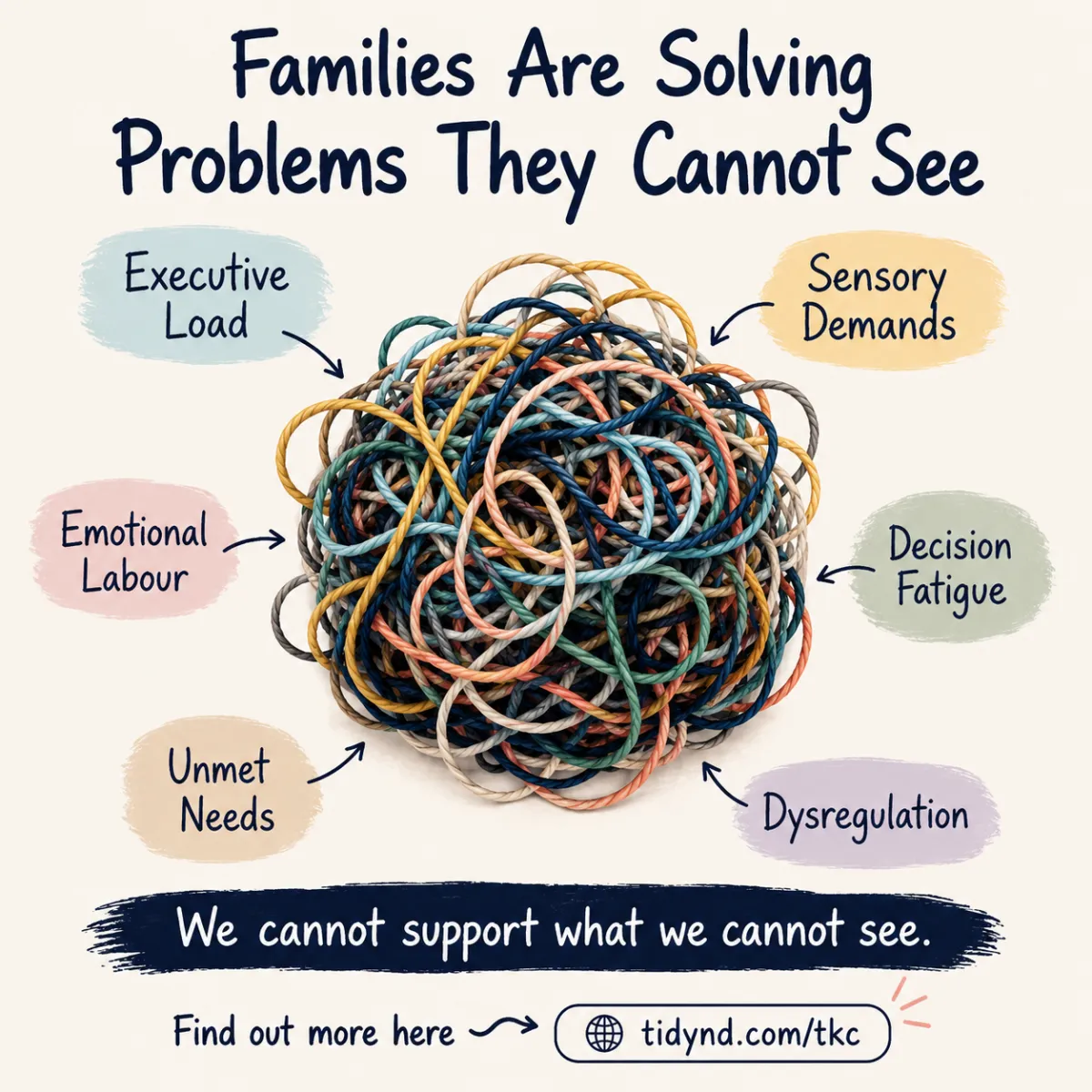
They may be connected to a collection of hidden factors operating underneath the surface.
What we see is usually the outcome.
What we do not see is often where the answer lives.
Why It Happens
Families are constantly navigating invisible demands.
Some belong to the child.
Some belong to the parent.
Some belong to the environment.
And many belong to the interaction between all three.
These hidden demands can include:
Executive load
Sensory demands
Emotional labour
Decision fatigue
Unmet needs
Dysregulation
Each one adds another strand to the tangled ball.
The challenge is that none of these things are always obvious.
You cannot see executive functioning the way you can see a toy left on the floor.
You cannot easily measure emotional labour at the end of a busy week.
You cannot always identify sensory overload before it becomes a meltdown.
Yet these factors shape behaviour every single day.
What Most People Miss
When families are struggling, the focus often lands on behaviour.
The child is arguing.
The child is refusing.
The child is melting down.
The child is avoiding.
The behaviour becomes the target.
But behaviour is often information rather than the problem itself.
It is the visible part of a much larger picture.
Imagine seeing smoke coming from a building.
You could spend all your energy waving the smoke away.
Or you could look for the source of the fire.
Many parenting strategies focus on managing the smoke.
TKC encourages families to become curious about the source.
The TKC Perspective
Nobody is the problem.
The pattern is the problem.
When we stop asking:
"How do I make this behaviour stop?"
and start asking:
"What might be making this harder than it looks?"
everything begins to shift.
The goal is not to excuse behaviour.
The goal is to understand it.
Understanding creates clarity.
Clarity creates effective support.
And effective support creates change.
When we can identify the hidden factors underneath a challenge, we move away from guessing and toward informed action.
A Practical Example
Let's imagine a child who has a meltdown every afternoon after school.
At first glance, it may appear that they are being difficult, oppositional, or unwilling to cooperate.
But what happens when we look underneath?
Perhaps they have spent six hours managing sensory demands in a noisy classroom.
Perhaps they have used enormous amounts of executive functioning to follow instructions, transition between tasks, and stay organised.
Perhaps they have been masking anxiety all day.
Perhaps they have not eaten enough.
Perhaps they have spent hours suppressing emotions that finally emerge when they feel safe at home.
Suddenly the picture changes.
The meltdown is no longer an isolated behaviour.
It is part of a larger pattern.
The support changes too.
Instead of increasing consequences, we might reduce demands.
Instead of asking for more compliance, we might create recovery time.
Instead of assuming defiance, we might recognise exhaustion.
The behaviour may look the same.
But our understanding becomes completely different.
Why This Matters for Parents
Many parents carry a heavy burden of self-doubt.
When strategies fail, they often assume they are failing too.
But sometimes the issue is not effort.
Sometimes it is visibility.
You cannot solve a something if half the pieces are missing.
You cannot support a need you cannot identify.
You cannot respond effectively to factors you do not know are there.
The more visible the pattern becomes, the more confident decision-making becomes.
Reflection Questions
The next time your family feels stuck, consider asking:
What might be happening underneath the behaviour?
What demands might currently be invisible?
Is there executive load involved?
Could sensory needs be contributing?
Is someone carrying more emotional labour than they realise?
Are we looking at the behaviour or the pattern?
These questions often reveal more than another strategy ever could.
Summary
Families are not usually struggling because they are unwilling.
Most are working incredibly hard.
The challenge is that many of the factors influencing behaviour remain hidden.
Executive load.
Sensory demands.
Emotional labour.
Decision fatigue.
Unmet needs.
Dysregulation.
These invisible experiences shape visible outcomes.
When we learn to see what sits underneath behaviour, we stop chasing symptoms and start understanding patterns.
And when we understand the pattern, support becomes clearer.
Because we cannot support what we cannot see.