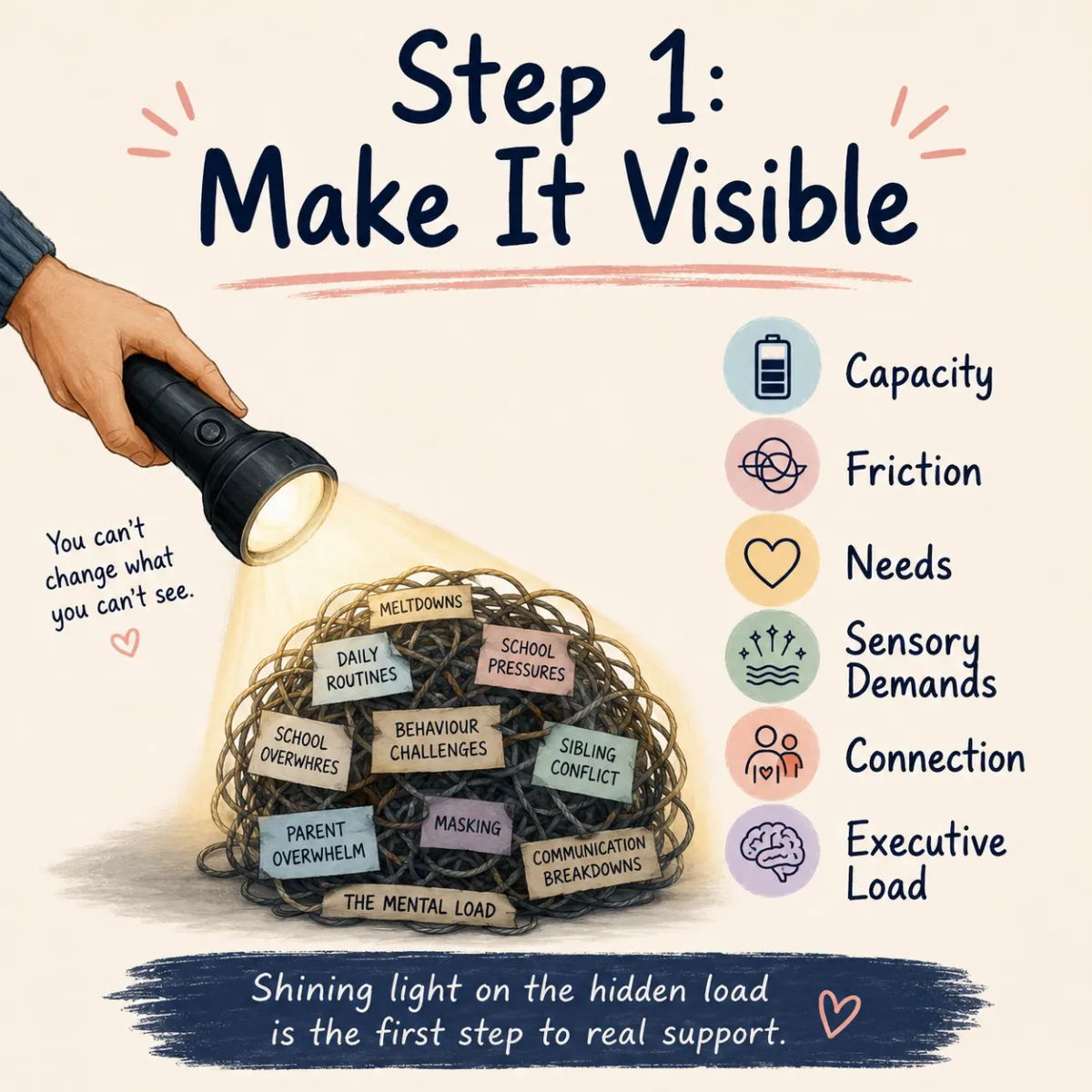
PT 2. Make It Visible
Make It Visible
Most families are trying to solve what they can see.
The meltdown.
The argument.
The refusal.
The unfinished homework.
The difficult morning.
The constant conflict between siblings.
The exhaustion at the end of the day.
These are the things that demand our attention because they are visible.
They are loud.
They disrupt family life.
They feel urgent.
But what if the visible problem is not where we need to start?
What if the first step is not fixing the behaviour?
What if the first step is making the hidden load visible?
What Families Usually See
A child won't get dressed.
A parent loses their patience.
Homework becomes a battle.
A routine falls apart.
Someone shuts down.
Someone explodes.
Someone withdraws.
From the outside, it can appear as though these are separate problems requiring separate solutions.
So families often look for a new strategy.
A new reward system.
A new consequence.
A new routine.
A new approach.
Yet many continue to feel stuck.
Not because they are doing something wrong.
But because they are trying to solve the visible outcome without understanding what is driving it.
The Hidden Load
Every family carries invisible demands.
Some belong to the child.
Some belong to the parent.
Some belong to the environment.
Some belong to the interaction between all three.
These demands are often hidden beneath the surface.
They can include:
Capacity
Friction
Needs
Sensory Demands
Connection
Executive Load
These are the things we cannot always see.
Yet they influence almost everything we do.
Capacity
Sometimes the issue is not willingness.
Sometimes it is capacity.
A child may know how to complete a task but not have enough energy to do it.
A parent may know what strategy they want to use but not have the emotional resources available in that moment.
When capacity is low, even simple tasks can feel impossible.
The behaviour we see may be less about choice and more about available resources.
Friction
Friction is anything that makes a task harder than it needs to be.
Transitions.
Unclear expectations.
Too many steps.
Competing demands.
Unexpected changes.
Families often try to increase motivation when the real issue is friction.
Removing obstacles can sometimes achieve more than adding rewards.
Needs
Every behaviour occurs in the context of needs.
Physical needs.
Emotional needs.
Sensory needs.
Connection needs.
Safety needs.
Belonging needs.
When needs remain unmet, behaviour often becomes communication.
Not because someone is trying to be difficult.
But because needs have a way of making themselves known.
Sensory Demands
Many children spend large parts of their day managing sensory information.
Noise.
Light.
Movement.
Crowded spaces.
Unpredictability.
Uncomfortably.
The need for movement.
The effort required to cope with these demands is often invisible to the people around them.
What appears to be a sudden meltdown may actually be the result of hours of sensory overload.
The behaviour is visible.
The sensory demand is not.
Connection
Human beings function best when they feel connected.
Children are no different.
When connection feels strained, behaviour often shifts.
Not because children are trying to create problems.
But because relationships influence regulation, cooperation, and resilience.
Connection is often one of the most overlooked factors in family wellbeing.
Yet, burnout parents would love to connect - but not at a steep cost to their own processing systems.
Connection should be made easy, simple, engaging and connecting - to everyone.
Executive Load
Executive functioning is our thinking brain. It allows us to plan, organise, prioritise, remember instructions, manage time, switch tasks, and regulate attention.
Many daily expectations place enormous executive demands on children.
Getting ready for school.
Packing a bag.
Following a morning routine.
Completing homework.
Managing transitions.
What appears to be refusal may actually be overwhelm.
What appears to be laziness may actually be executive load exceeding capacity.
When we understand the demand, we can offer support that matches the need.
And the same goes for parents on a tough day. It happens to the best of us.
Why Visibility Changes Everything
Imagine trying to solve something while half the instructions remain lost.
No matter how hard you work, the picture never quite makes sense.
Many families experience exactly this.
They are working incredibly hard.
But they are missing vital information.
The moment hidden demands become visible, new possibilities emerge.
The conversation changes.
The support changes.
The solutions change.
Instead of asking:
"How do we stop this behaviour?"
We begin asking:
"What might be making this harder than it looks?"
That question often reveals far more than another strategy ever could.
The TKC Perspective
Nobody is the problem.
The pattern is the problem.
The goal is not to find fault.
The goal is to find understanding.
Because understanding creates clarity.
Clarity creates effective support.
And effective support creates meaningful change.
This is why Step 1 is always the same.
Make it visible.
Look for capacity.
Look for friction.
Look for needs.
Look for sensory demands.
Look for connection.
Look for executive load.
Because we cannot support what we cannot see.