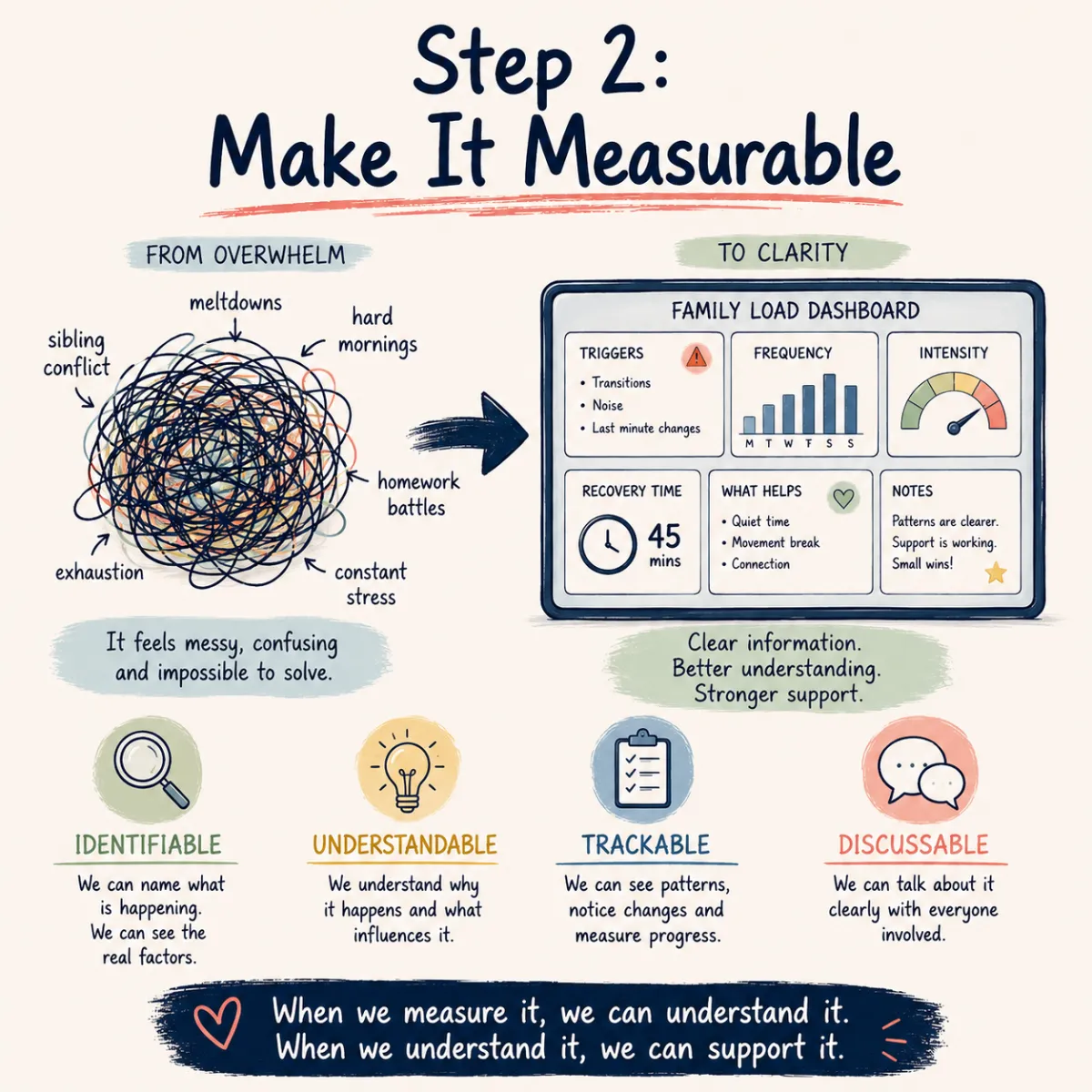
Pt 3: Make It Measurable
Make It Measurable
Once we make the hidden load visible, the next step is making it measurable.
Because seeing a problem is important.
But understanding it is where change begins.
Many families spend years describing their experience using words like:
"Everything feels hard."
"We're constantly overwhelmed."
"I don't know what's wrong."
"It changes every day."
"We've tried everything."
These experiences are real.
But they can also feel impossible to solve because they are difficult to define.
And it is very hard to support something that feels invisible, vague, and constantly moving.
This is why this step matters so much.
Make it measurable.
Why Measurement Matters
When something becomes measurable, it becomes easier to understand.
When it becomes easier to understand, it becomes easier to discuss.
When it becomes easier to discuss, it becomes easier to support.
Most families are not lacking effort.
They are lacking clarity.
They know something is happening.
They just cannot yet see the pattern clearly enough to work with it.
Most people are unable to clearly define the needs in the families.
Often we expect professionals to have this ready to go for us, but many do not.
With measurement helps transform confusion into information.
What Most Families Do
Imagine a parent saying:
"My child is always overwhelmed."
That may be true.
But what does overwhelmed actually mean?
When does it happen?
How often?
Under what conditions?
What happens immediately before it?
What helps?
What makes it worse?
Without these details, everyone is left guessing.
Parents guess.
Teachers guess.
Professionals guess.
Even the child will probably guess.
The more guessing involved, the harder it becomes to create meaningful support, put your own words to it and get needs met.
Turning Information Into Understanding
Making something measurable does not mean turning family life into a spreadsheet.
It means becoming curious enough to notice patterns.
For example:
Instead of:
"My child has meltdowns all the time."
We might discover:
"Meltdowns happen most often after school, during transitions, and when there have been unexpected changes."
That is measurable.
Instead of:
"Mornings are a disaster."
We might discover:
"The most difficult part of the morning is getting dressed, particularly when there are multiple instructions given at once."
That is measurable.
Instead of:
"I'm constantly exhausted."
We might discover:
"I make more than 200 family-related decisions before lunch."
That is measurable.
The problem becomes clearer.
And clear problems are easier to solve.
What Measurement Creates
At TKC, measurement is not about judgement.
It is about understanding.
We want hidden experiences to become:
Identifiable
Can we name what is happening?
Can we separate one challenge from another?
Can we identify the actual demand?
Many families discover that what they thought was one large problem is actually several smaller and more manageable ones.
Understandable
Can we explain the pattern?
Can we see what influences it?
Can we understand why it happens?
Understanding reduces self-doubt.
When families understand the pattern, they stop assuming someone is failing.
They start recognising what is actually driving the difficulty.
Trackable
Can we notice changes over time?
Can we see improvements?
Can we identify trends?
Can we recognise what is helping?
Without measurement, progress often goes unnoticed.
Families may be moving forward without realising it.
Tracking creates evidence of growth.
Discussable
Can everyone talk about the challenge using the same language?
Can parents, educators, therapists, and children describe the same pattern?
Shared understanding creates better collaboration.
The goal is not perfect agreement.
The goal is having a common picture to work from.
A Practical Example
Imagine a child who struggles every afternoon.
At part 2, we make the hidden load visible.
We identify possible sensory demands, executive load, and reduced capacity after school.
At part 3, we make those observations measurable.
We notice:
Difficulties occur four days out of five.
They begin within thirty minutes of arriving home.
They are more intense after noisy school days.
They reduce significantly after quiet recovery time.
They increase when demands are placed immediately after school.
Now the family has something concrete.
The experience is no longer just a feeling.
It is a pattern.
And patterns can be understood.
The TKC Perspective
Nobody is the problem.
The pattern is the problem.
Patterns become easier to support when they become easier to see.
And they become easier to see when they become measurable.
This is not about collecting data for the sake of data.
It is about creating understanding.
Because understanding reduces blame.
Understanding reduces confusion.
Understanding creates confidence.
And confidence helps families make decisions that actually fit their situation.
Summary
If we make the hidden load visible.
Then we make the hidden load measurable.
We move from:
"I know something is wrong."
To:
"I understand what is happening."
We make challenges:
Identifiable
Understandable
Trackable
Discussable
Because once a pattern becomes measurable, it stops being a mystery.
And when it stops being a mystery, meaningful support becomes possible.
This is something we are implementing with in TKC, doing the measuring for you.
Make the action plans and make the actions actually actionable.