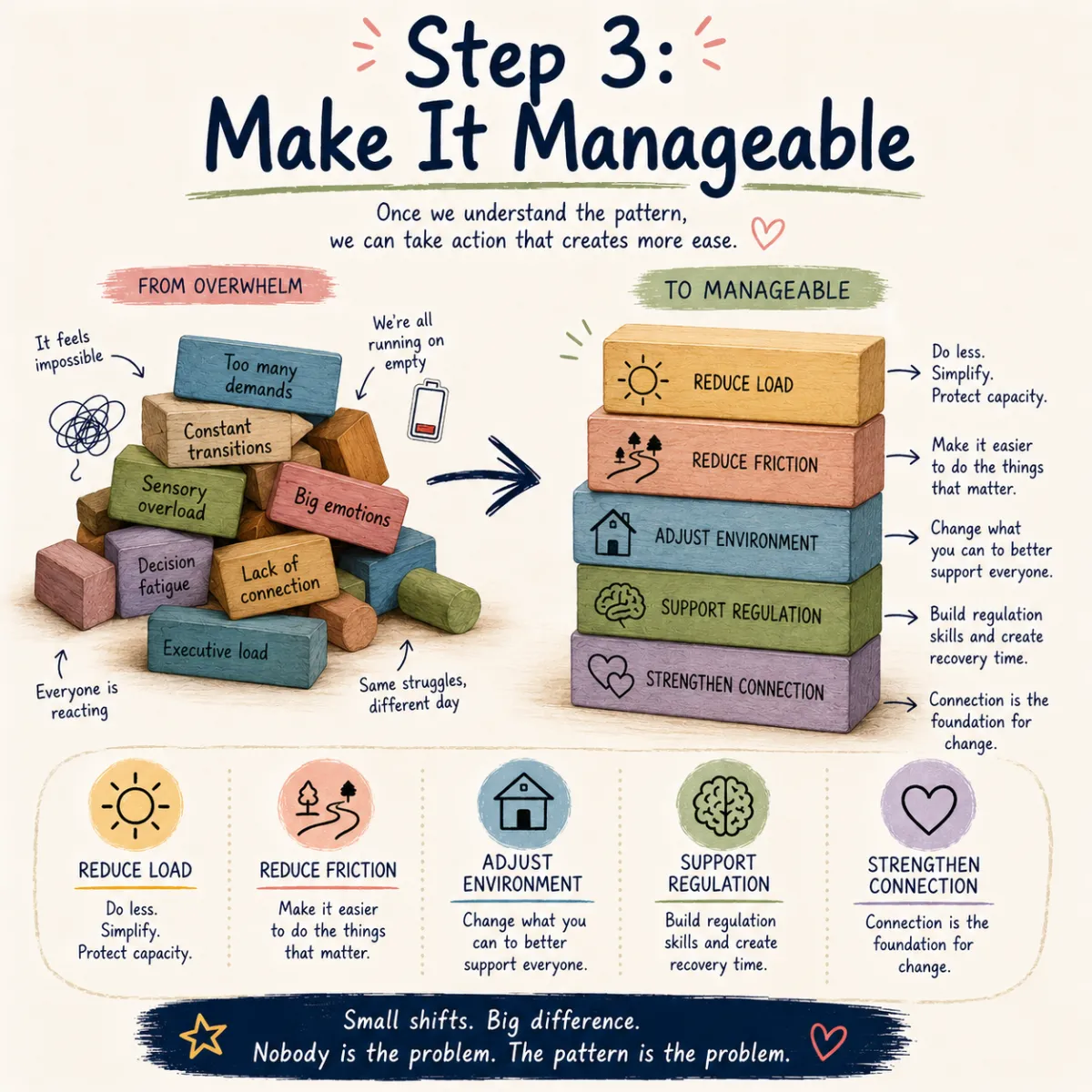
Pt 4. Make It Manageable
Make It Manageable
By the time families reach this step, something important has happened.
The hidden load has been made visible.
The patterns have become measurable.
The confusion has started to make sense.
Now comes the question every family eventually asks:
"What do we do with this information?"
This is where many parenting approaches get stuck.
They become very good at identifying problems.
Very good at describing challenges.
Very good at understanding behaviour.
But understanding alone does not create change.
Eventually, families need support that makes everyday life more manageable.
Not perfect.
Not effortless.
Manageable.
The Goal Is Not More Effort
When families are struggling, the most common advice often sounds like this:
Try harder.
Be more consistent.
Stay firmer.
Keep going.
Push through.
The problem is that most families are already trying incredibly hard.
Many are operating at maximum capacity.
They are exhausted.
Overloaded.
Running on empty.
The answer is rarely asking people to carry more.
The answer is often helping them carry less.
Why Behaviour Changes When Conditions Change
Behaviour does not exist in isolation.
It exists within a system.
A child's capacity.
A parent's capacity.
The environment.
The demands being placed on everyone.
The level of support available.
When conditions become more manageable, behaviour often becomes more manageable too.
Not because anyone changed who they are.
But because the environment changed what was possible.
This is one of the most important shifts in the TKC approach.
Instead of asking:
"How do we change the person?"
We ask:
"How do we change the conditions?"
Reduce Load
Many families are carrying more than they can realistically sustain.
Too many demands.
Too many expectations.
Too many decisions.
Too many transitions.
Too many things competing for limited capacity.
Sometimes support starts with subtraction.
Not addition.
Reducing load might mean:
Removing unnecessary tasks.
Simplifying structures.
Protecting recovery time.
Reducing expectations during difficult periods.
Prioritising what matters most.
When load decreases, capacity increases.
It doesn't mean boring.
It doesn't mean losing out.
Reduce Friction
Some tasks are difficult because they are difficult.
Others are difficult because they contain unnecessary friction.
Friction is anything that makes success harder than it needs to be.
Too many steps.
Unclear instructions.
Unexpected changes.
Complicated systems.
Competing demands.
Families often try to increase motivation when reducing friction would be far more effective.
Small adjustments can create surprisingly large changes.
Adjust the Environment
The environment influences behaviour every day.
Noise.
Lighting.
Clutter.
Transitions.
Schedules.
Physical spaces.
Sensory demands.
The environment is often easier to change than people.
Yet it is frequently overlooked.
When we adjust the environment, we reduce the amount of effort required to function within it.
But it is not as simple as packing things away.
A child who struggles in a noisy environment may not need more consequences.
They may need less noise.
A parent who feels overwhelmed may not need more strategies.
They may need fewer demands competing for attention.
But that is not easy to achieve when you are overrun.
That's something we take into consideration at TKC.
Support Regulation
Many challenges are not skill problems.
They are regulation problems.
A child may know exactly what to do.
But accessing that skill becomes difficult when overwhelmed.
The same is true for adults.
When regulation decreases, behaviour often changes.
Supporting regulation means creating opportunities for recovery.
Movement.
Rest.
Connection.
Sensory supports.
Predictability.
Co-regulation.
That works for everyone in the household.
The goal is not simply getting through difficult moments.
The goal is building the conditions that make difficult moments less likely.
Strengthen Connection
Connection is often the foundation that supports everything else.
When people feel connected, they are more likely to cooperate.
More likely to communicate.
More likely to recover from challenges.
More likely to feel safe.
Connection does not solve every problem.
But it makes solving problems easier.
This is why relationship-building is never separate from support.
It is support.
But it is hard to connect when you are not sure how to,
or when you are already operating on fumes.
At TKC we notice this and put it as part of our plans.
Small Shifts Create Big Changes
Many families believe change requires a complete overhaul.
A new system.
A new program.
A new approach.
Sometimes meaningful change starts much smaller.
One demand removed.
One transition simplified.
One sensory support added.
One moment of connection protected.
One source of friction reduced.
These small adjustments often create ripple effects throughout the entire family system.
Because when conditions improve, outcomes often improve too.
That is what we focus on over here.
The TKC Perspective
Nobody is the problem.
The pattern is the problem.
And patterns become manageable when we stop trying to force people to fit impossible conditions.
Instead, we create conditions that support people.
We reduce load.
Reduce friction.
Adjust environments.
Support regulation.
Strengthen connection.
The goal is not perfection.
The goal is creating enough ease that families can function, recover, grow, and thrive.
Summary
Step 1 is making the hidden load visible.
Step 2 is making the pattern measurable.
Step 3 is making support manageable.
We stop asking:
"How do we make people work harder?"
And start asking:
"How do we make life work better?"
Because sustainable change rarely comes from adding more pressure.
It comes from creating better conditions.
Reduce load.
Reduce friction.
Adjust the environment.
Support regulation.
Strengthen connection.
Because when we change the conditions, behaviour often changes too.