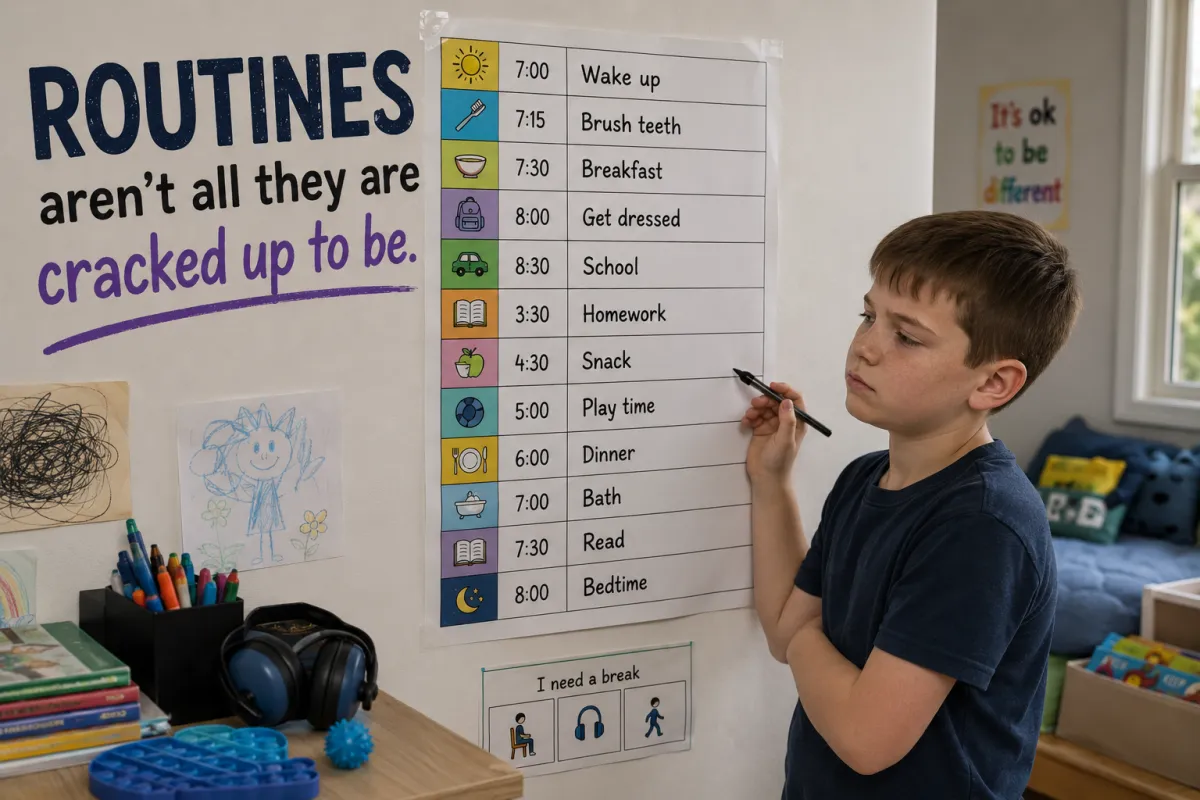
Routine-Dilemma
Why “Routines” Often Fail Neurodiverse Kids
One of the biggest misconceptions in parenting neurodiverse kids is this idea that they simply “need more routine.”
And attached to that idea is something even more dangerous:
rigidity.
Merriam-Webster defines rigidity as:
“deficient in or devoid of flexibility.”
Another way to understand it is this:
maintaining the outer shape through a fixed framework.
Let’s pause there for a moment.
The outer shape.
Why does that feel so painfully familiar to the lived experience of so many autistic and neurodiverse children?
More charts.
More schedules.
More structure.
More consistency.
Fixed frameworks designed to hold behaviour together externally…
while often completely ignoring what is happening internally.
And while that sounds logical on paper…
for many ND kids, rigid routines can actually become part of the problem.
Because routines are not the same thing as safety.
And this distinction matters more than most people realise.
The Nervous System Doesn’t Run on Routine
At the deepest level, the nervous system runs on prediction.
Every human nervous system is constantly asking:
What is likely to happen next?
Am I safe?
Do I need to prepare?
The brain builds these predictions from repeated lived experiences.
Not from parenting books.
Not from reward charts.
Not from visual schedules stuck to the fridge.
From experience.
If a child repeatedly experiences unpredictability, overwhelm, shame, disconnection, or emotional dismissal, their nervous system learns to predict those things.
Even inside a perfectly structured home.
A child can have:
the same bedtime every night
the same dinner every Tuesday
the same school drop-off routine
…and still live in a body that feels deeply unsafe.
Because routine is external.
Prediction is internal.
Consistency and Routine Are Not the Same Thing
This is where parents get trapped.
We’re taught:
“If we can just get them into a routine, everything will improve.”
But routine is only one tiny piece of regulation.
Consistency is what actually shapes nervous system safety.
Consistency means:
emotional responses make sense
connection remains available
needs are responded to predictably
support doesn’t disappear suddenly
care isn’t conditional on behaviour
That is what slowly changes prediction.
For example:
If every morning consistently includes:
enough food
calm presence
connection
predictable care
…the nervous system slowly starts updating its expectation map.
It begins to predict:
“Care keeps arriving.”
“I don’t need to panic.”
“I don’t need to brace.”
That is regulation work.
Not forcing a child through a rigid morning checklist while everyone is dysregulated and overwhelmed.
Why Rigid Routines Can Backfire for ND Kids
Many neurodiverse kids already live in nervous systems that are hyper-alert to pressure, unpredictability, correction, sensory overwhelm, and perceived failure.
So when routine becomes rigid, controlling, or compliance-based, it often creates even more nervous system threat.
Especially when:
transitions are hard
sensory demands are high
executive functioning fluctuates
energy capacity changes daily
stress tolerance is inconsistent
A routine that “should” feel supportive can quickly become another place the child experiences:
failure
pressure
shame
urgency
constant correction
And then parents end up confused because:
“But we HAVE routines.”
Yes.
But routines without nervous system safety are just repeated stress patterns.
Regulation Cannot Be Forced Through Structure
This is the part most mainstream parenting approaches miss.
You cannot schedule a nervous system into safety.
You cannot behaviour-chart a child out of survival states.
You cannot force regulation through enough colour-coded systems.
Because the nervous system is not responding to the routine itself.
It is responding to:
the emotional environment
the level of safety
the predictability of connection
the felt experience inside the interaction
That’s why two homes can use the exact same routine…
…and one child thrives while another spirals.
The difference is not the chart.
The difference is the nervous system experience happening inside the structure.
What Actually Helps Neurodiverse Kids Feel Safer
What helps is not “perfect routine.”
What helps is intentional consistency that builds new predictions.
Repeated experiences that teach:
support stays available
needs are allowed
mistakes are survivable
overwhelm is understood
connection does not disappear during hard moments
This is nervous system rebuilding work.
And it happens slowly.
Through repeated lived experience.
Not through forcing compliance.
This is where intentional abundance-building experiences matter.
Because you are not trying to force fake positivity onto a struggling nervous system.
You are intentionally creating repeated experiences that slowly teach the body:
“There is enough.”
“Support continues.”
“Care does not disappear.”
“I do not need to panic.”
For many ND kids — and honestly, many ND adults too — we are often operating from old nervous system predictions built in scarcity, unpredictability, correction, or emotional survival.
The work is not pretending those experiences never happened.
The work is creating enough consistent new experiences that the nervous system slowly stops expecting danger everywhere.
That is how prediction changes.
At TIDY ND, We Parent Differently
Here at TIDY ND, we do not believe neurodiverse kids need stricter systems to become more manageable.
We believe they need environments that actually work with their nervous systems instead of against them.
That means:
understanding behaviour through regulation, not obedience
reducing chronic nervous system threat
creating flexible supports instead of rigid control
building safety before demanding performance
helping parents understand what is happening underneath the behaviour
We are not interested in raising compliant children who look regulated from the outside while internally living in survival mode.
We care about helping ND kids feel safe enough to actually function.
Because when the nervous system no longer has to spend every second preparing for threat…
everything changes.
The goal is not perfect routines.
The goal is safer predictions.
And those are built through repeated experiences of:
connection
understanding
flexibility
co-regulation
emotional safety
intentional abundance instead of chronic scarcity
That is the work.
And honestly?
That changes far more than any routine chart ever could.