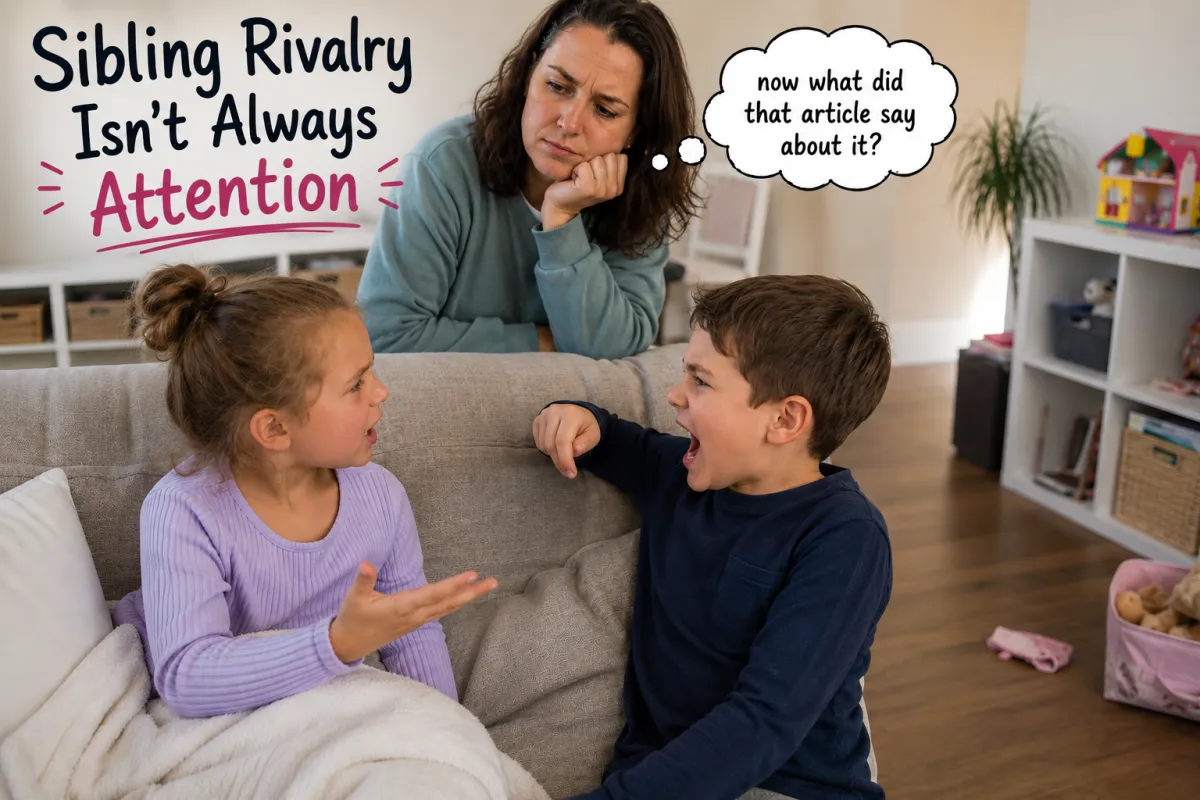
Sibling Rivalry Isn't Always About Attention
Sibling Rivalry Isn't Always About Attention
Sometimes it's a connection paradox.
Two children wanting connection.
Two children needing relationship.
But each child defining safety in completely different ways.
And when those definitions collide, conflict becomes almost inevitable.
Child One Says:
"I want connection, but only if it feels predictable."
Predictability creates safety.
They want to know:
what's happening
what's expected
where they fit
whether the interaction will stay within manageable limits
Too much unpredictability feels threatening.
Too much spontaneity feels overwhelming.
Too much emotional intensity feels unsafe.
So they seek control, certainty, and structure.
Not because they're difficult.
Because predictability is how their nervous system experiences connection.
Child Two Says:
"I want connection, but connection means participating."
Connection is movement.
Interaction.
Engagement.
Shared experiences.
Play.
Conversation.
Influence.
Response.
For this child, relationship feels alive when people are actively involved.
If the other child won't engage, won't play their way, won't respond how they expect, connection can feel absent.
Not because it is absent.
Because their definition of connection is participation.
The Collision
One child seeks safety through predictability.
The other seeks safety through engagement.
One protects connection by reducing uncertainty.
The other protects connection by increasing interaction.
Neither child is wrong.
Neither child is trying to create conflict.
They're simply solving different nervous-system operations happening.
But from each child's perspective, the other becomes the problem.
The predictable child sees intrusion.
The participatory child sees rejection.
The predictable child withdraws.
The participatory child pushes harder.
The more one retreats, the more the other pursues.
The more one pursues, the more the other retreats.
And suddenly everyone is fighting.
When Both Children Lose
This is the heartbreaking part.
Both children are often trying to achieve the same thing.
Connection.
But their strategies make connection harder to achieve.
One feels pressured.
One feels excluded.
One feels invaded.
One feels ignored.
Both leave feeling misunderstood.
And adults looking from the outside often see only behaviour.
And it can be utterly exhausting to manage the conflict.
The arguing.
The provoking.
The controlling.
The clinginess.
The refusal.
The explosions.
What we usually miss is the need underneath.
Two children trying to connect.
Using completely incompatible maps.
A Different Question
Instead of asking:
"Who started it?"
Or:
"Why can't they just get along?"
We might ask:
"What does connection mean to each child?"
Because sibling conflict is not always a battle for attention.
Sometimes it's a collision between two nervous systems pursuing relationship in entirely different ways.
One child saying:
"Stay predictable so I can stay connected."
The other saying:
"Join me so I can feel connected."
And when those collide, both children lose.
Until someone helps translate.
Not the behaviour.
The need.
Because once we can see the need, the conflict starts making a lot more sense.
Need more help achieving this? Sign up to the newsletter.