The Big Behaviour Weather Report Frameworkk
The Big Behaviour Weather Report Framework
Why Behaviour Doesn't Come Out of Nowhere
When a child yells, hits, refuses, runs away, shuts down, melts down, or completely falls apart, most people focus on the storm.
The behaviour is loud.
It's visible.
It's disruptive.
And because it's the part everyone can see, it's often where support begins.
But what if the storm isn't actually the beginning of the story?
What if it's the end?
That's the idea behind the Big Behaviour Weather Report Framework.
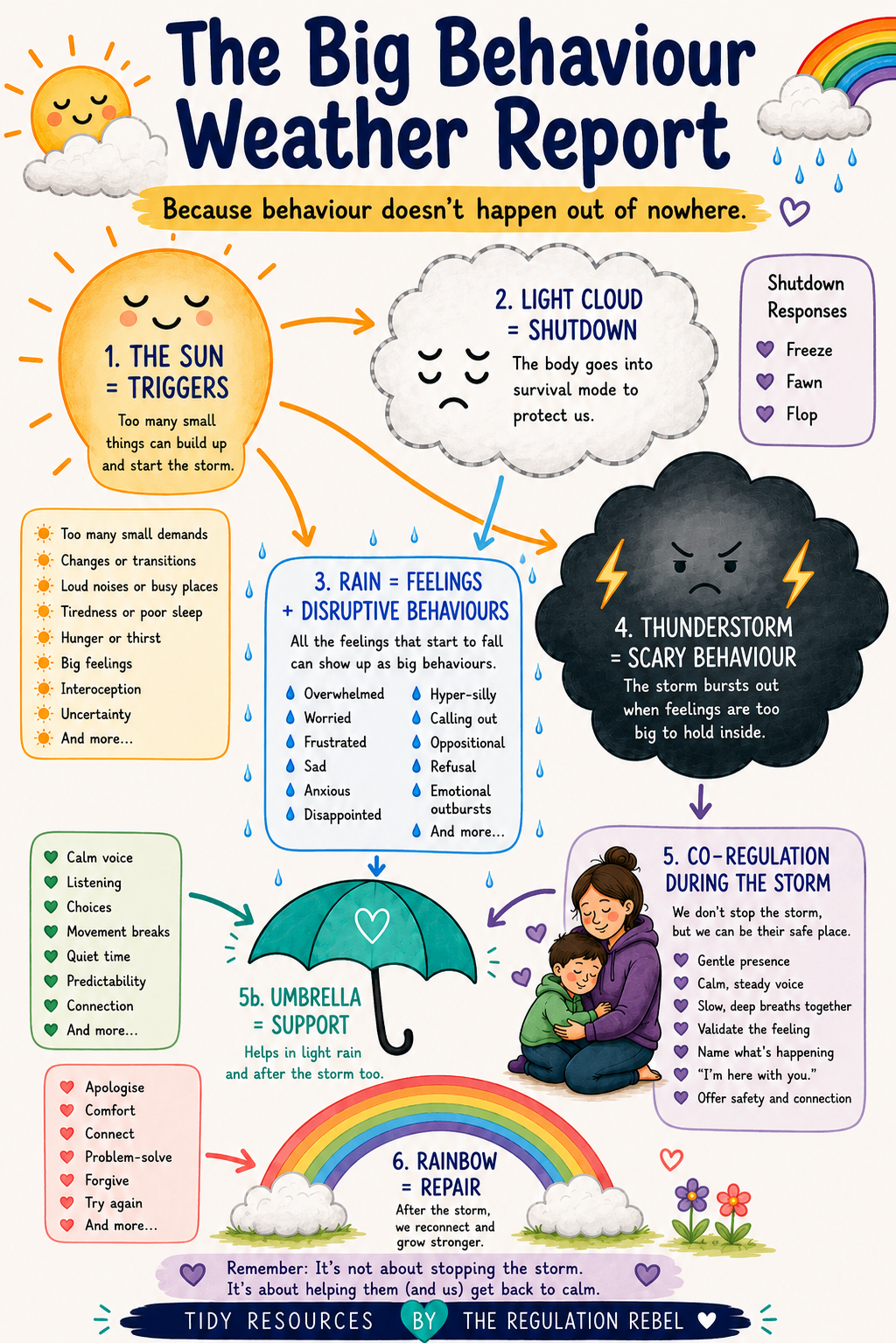
This framework was created to help parents understand that behaviour rarely appears out of nowhere. Just like weather, there is usually a sequence of events happening long before the storm arrives.
And when we learn to recognise the weather pattern, we stop seeing children as the problem and start understanding what their nervous system might be trying to communicate.
Because nobody is the problem.
The pattern is the problem.
Most Behaviour Frameworks Start Too Late
Many traditional behaviour approaches focus on what happens when behaviour becomes visible.
The tantrum.
The aggression.
The refusal.
The shouting.
The emotional outburst.
The meltdown.
The shutdown.
These behaviours are often labelled as:
Defiant
Oppositional
Attention-seeking
Manipulative
Naughty
Lazy
Avoidant
Difficult
But these labels only describe what we can see.
They don't explain why it's happening.
And they certainly don't tell us what support is needed.
The Big Behaviour Weather Report Framework looks earlier in the process.
Instead of starting with the storm, it starts with the sun.
Step 1: The Sun - Triggers
At first, the sun seems like an unusual place to begin.
After all, storms are caused by clouds, aren't they?
Not quite.
In weather, the sun creates evaporation.
The sun heats the ground and water.
That water rises into the atmosphere and forms clouds.
Without the sun, there are no clouds.
Without the clouds, there is no storm.
The same thing happens with behaviour.
The "sun" represents all the small stressors, demands, challenges, and experiences that build throughout the day.
Things like:
☀️ Poor sleep
☀️ Hunger or thirst
☀️ Sensory overload
☀️ Loud environments
☀️ Changes in routine
☀️ Unexpected transitions
☀️ Social pressure
☀️ Big emotions
☀️ Interoception difficulties
☀️ Too many demands
☀️ Feeling misunderstood
None of these things may seem significant on their own.
But behaviour isn't usually caused by one thing.
It's caused by accumulation.
Just like weather.
Step 2: The Clouds - Shutdown
This is one of the most overlooked parts of behaviour.
Many frameworks move directly from trigger to meltdown.
But that's not what many children experience.
Often there is a cloud stage first.
The nervous system begins moving into protection mode.
The child may:
Withdraw
Go quiet
Stop participating
Freeze
Become disconnected
Seem unmotivated
Avoid interaction
Adults often interpret this as:
Laziness
Ignoring
Rudeness
Lack of effort
Not caring
But from a nervous system perspective, many children are not choosing these responses.
They're surviving.
Their body is trying to manage an increasing level of stress.
The clouds are gathering.
Step 3: The Rain - Feelings Spilling Out
As stress continues building, emotions begin to leak out.
The rain represents feelings and behaviours that show us a child is struggling.
This might look like:
💧 Worry
💧 Frustration
💧 Anxiety
💧 Sadness
💧 Refusal
💧 Calling out
💧 Emotional reactions
💧 Hyperactivity
💧 Silliness
💧 Increased sensitivity
💧 Argumentative behaviour
Many adults focus on stopping the rain.
But the rain is information.
It's telling us the storm system is growing.
When we respond here, we often have the greatest opportunity to help.
Step 4: The Thunderstorm - Scary Behaviour
Eventually the storm arrives.
This is the behaviour that gets everyone's attention.
The aggression.
The screaming.
The meltdown.
The explosive reaction.
The complete emotional overwhelm.
This is often the point where adults feel helpless.
But the thunderstorm isn't random.
It isn't manipulation.
It isn't a child plotting to make life difficult.
It's often what happens when feelings become too big to contain.
The nervous system has reached capacity.
The storm bursts because there is nowhere else for the pressure to go.
Step 5: The Umbrella - Support
One of the biggest mistakes adults make is trying to stop the storm.
Storms don't stop because we demand they stop.
The same is true for nervous systems.
When a child is overwhelmed, what they need most is support.
The umbrella represents the things that help reduce stress and create safety.
Things like:
☂️ Connection
☂️ Calm presence
☂️ Listening
☂️ Predictability
☂️ Gentle guidance
☂️ Reduced demands
☂️ Movement breaks
☂️ Quiet spaces
☂️ Co-regulation
An umbrella doesn't stop rain.
But it helps us move through it safely.
Step 6: Co-Regulation During the Thunderstorm
When the thunderstorm is happening, children don't need lectures.
They don't need consequences.
They don't need long explanations.
They need someone who can help their nervous system feel safe enough to come back online.
This might sound like:
"I can see this is really hard."
"I'm here with you."
"We'll figure this out together."
"Let's take some slow breaths."
The goal isn't to control the storm.
The goal is to become a safe place within it.
Step 7: The Rainbow - Repair
Eventually, every storm passes.
And when it does, we have an opportunity for repair.
Repair might involve:
🌈 Reconnecting
🌈 Comforting
🌈 Problem-solving together
🌈 Reflecting on what happened
🌈 Practising skills
🌈 Trying again
Repair isn't about blame.
It's about learning.
It's about strengthening connection after a difficult moment.
It's about helping children understand that relationships remain safe, even after hard days.
What Makes This Framework Different?
The Big Behaviour Weather Report Framework doesn't just focus on behaviour.
It focuses on the entire weather system.
Many approaches start at the thunderstorm.
This framework starts at the sun.
It recognises:
The build-up before behaviour
The importance of shutdown
The role of feelings
The impact of nervous system states
The value of co-regulation
The power of repair
Most importantly, it helps parents stop asking:
"How do I stop this behaviour?"
And start asking:
"What weather pattern am I seeing?"
Because when we understand the weather, behaviour starts making sense.
And when behaviour makes sense, we can respond with understanding instead of confusion.
The Takeaway
The next time your child experiences a storm, try looking beyond the thunder.
Ask yourself:
What was the sun today?
Were there clouds gathering?
Did I notice the rain?
What support might have helped?
How can we repair afterwards?
Because behaviour doesn't appear out of nowhere.
Just like weather, there's usually a pattern.
And when we understand the pattern, everything changes.
Find out more here.