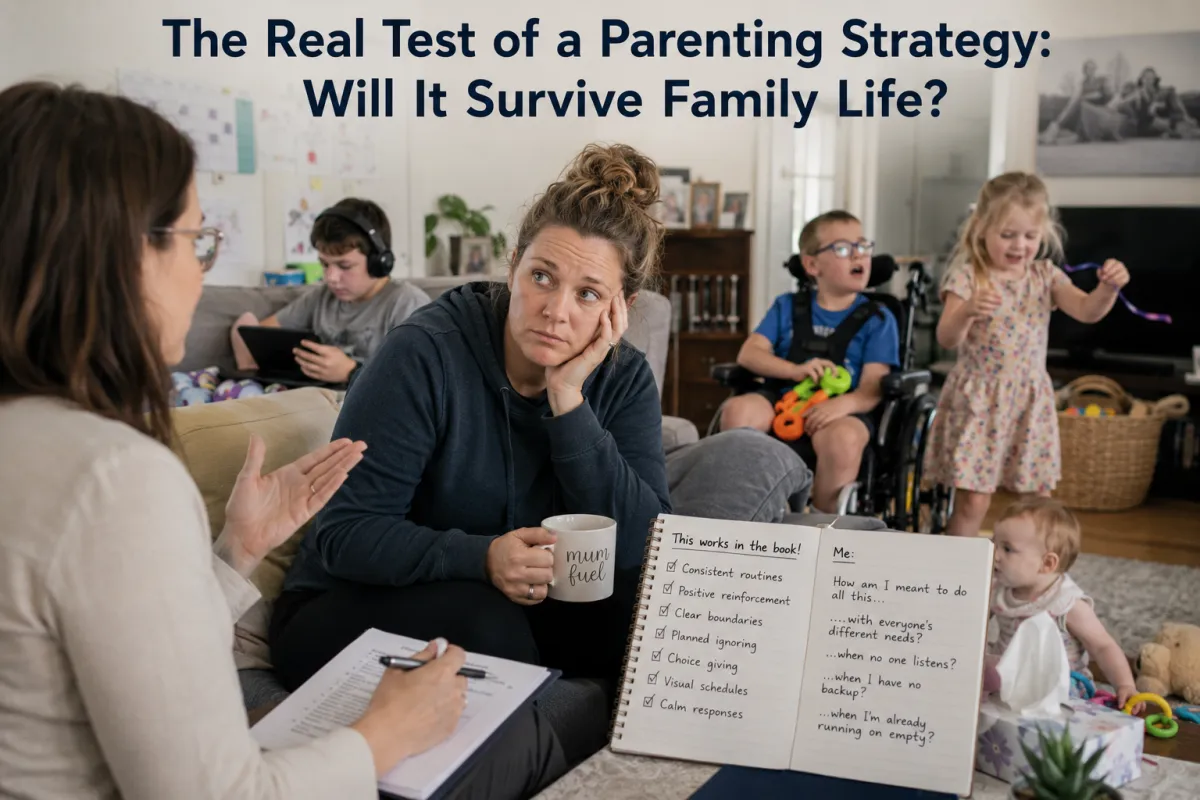
The Real Test of a Parenting Strategy: Will It Survive Family Life?
The Real Test of a Parenting Strategy: Will It Survive Family Life?
When parents discover a new parenting approach, the first question is usually:
"Will this work?"
It's a reasonable question.
But at TKC, we often find ourselves asking a different one:
"Will this survive everyday family life?"
Because those are not the same thing.
Many strategies work beautifully in theory.
Many make perfect sense conceptually.
Many are supported by excellent intentions.
And yet they quietly disappear after a few weeks.
Not because the child resisted.
Not because the parent lacked commitment.
But because the system required more executive labour than the family could realistically sustain.
Why Good Ideas Often Fail
Most parenting systems are evaluated based on outcomes.
Did behaviour improve?
Did skills develop?
Did routines become easier?
These questions matter.
But there is another variable that often gets overlooked:
What did it cost the parent to maintain the system?
A strategy may be highly effective while simultaneously being unsustainable.
And if it cannot be sustained, its effectiveness becomes largely irrelevant.
The Hidden Cost of Many Parenting Systems
Consider how many parenting tools rely on ongoing parent management.
Sticker charts.
Reward systems.
Behaviour tracking.
Point systems.
Progress monitoring.
Data collection.
Visual recording.
Consistency logs.
None of these things are inherently problematic.
But they all require something.
Executive labour.
The parent becomes responsible for:
Remembering the system
Monitoring behaviour
Recording outcomes
Tracking progress
Maintaining motivation
Updating rewards
Troubleshooting breakdowns
In many families, this work falls onto the same person who is already carrying the majority of the family's cognitive load.
The intervention becomes another open tab.
Another responsibility.
Another thing to manage.
The Parent Becomes the Operating System
This is something we talk about frequently at TKC.
Many parents become the invisible operating system of the family.
They are:
Tracking everyone's needs
Monitoring emotional states
Anticipating challenges
Coordinating schedules
Managing transitions
Carrying unresolved decisions
The family functions because they are constantly sensing what is happening.
Constantly gathering information.
Constantly adjusting.
The challenge is that this sensing role is exhausting when only one person is doing it.
What You're Really Teaching
This is why the concept of teaching children to become sensors is so powerful.
Because the goal isn't really chores.
Or cleaning.
Or obedience.
Or compliance.
The deeper goal is awareness.
You're teaching children to notice.
To observe.
To gather information.
To recognise patterns.
To become active participants in understanding the systems around them.
In other words, you're gradually transferring some of the sensing work that parents have traditionally carried alone.
That's a very different objective.
And it creates very different outcomes.
Why Simplicity Matters
One of the most appealing aspects of sensor-based learning is that it is capacity-friendly.
Especially for families already stretched thin.
It doesn't require:
Sticker charts
Point systems
Tracking sheets
Behaviour logs
Reward management
Ongoing data collection
Instead, it can happen through simple conversations.
Questions asked:
In the car
At dinner
During a walk
In the lounge room
During everyday moments
The interaction may take less than a minute.
That matters more than most people realise.
Sustainability Is Not a Bonus Feature at TKC
Many parenting resources treat sustainability as a secondary concern.
At TKC, we see it differently.
Sustainability is part of effectiveness.
Because a strategy that requires more capacity than a family possesses will eventually collapse under its own weight.
Not because the family failed.
Because the design failed.
A support strategy must fit inside real life.
Real life includes:
Tired parents
Interrupted routines
Competing demands
Reduced capacity
Limited executive resources
Any intervention that ignores these realities risks becoming another burden.
A Practical Example
Imagine two approaches to teaching awareness.
The first involves:
Daily tracking sheets
Weekly reviews
Reward systems
Progress charts
Behaviour monitoring
The second involves a simple question:
"What did you notice?"
Asked during everyday life.
One approach requires ongoing administration.
The other builds observation into existing interactions.
Both may create learning.
But one places significantly less demand on the parent.
Over time, that difference becomes enormous.
The TKC Perspective
At TKC, we are deeply interested in reducing unnecessary executive labour within family systems.
Not because parents shouldn't support their children.
But because exhausted systems are difficult to sustain.
When evaluating a strategy, we encourage parents to ask:
What is this teaching?
Who has to maintain it?
What executive labour does it require?
Is it realistic for this family?
Will it reduce cognitive load over time or increase it?
These questions matter.
Because family wellbeing depends not only on outcomes, but on sustainability.
Summary
The most brilliant parenting system in the world is useless if it requires more executive labour than a family can realistically provide.
That doesn't make the family the problem.
It means the intervention doesn't fit the system.
At TKC, we're interested in approaches that work with family capacity rather than against it.
Approaches that teach children to become observers.
Pattern spotters.
Sensors.
Approaches that reduce dependence on parent management over time rather than increasing it.
Because the ultimate goal isn't creating a perfect system.
It's creating a sustainable one.
And often the most effective support is the support that quietly reduces the burden being carried by the parent.
Nobody is the problem.
The pattern is the problem.