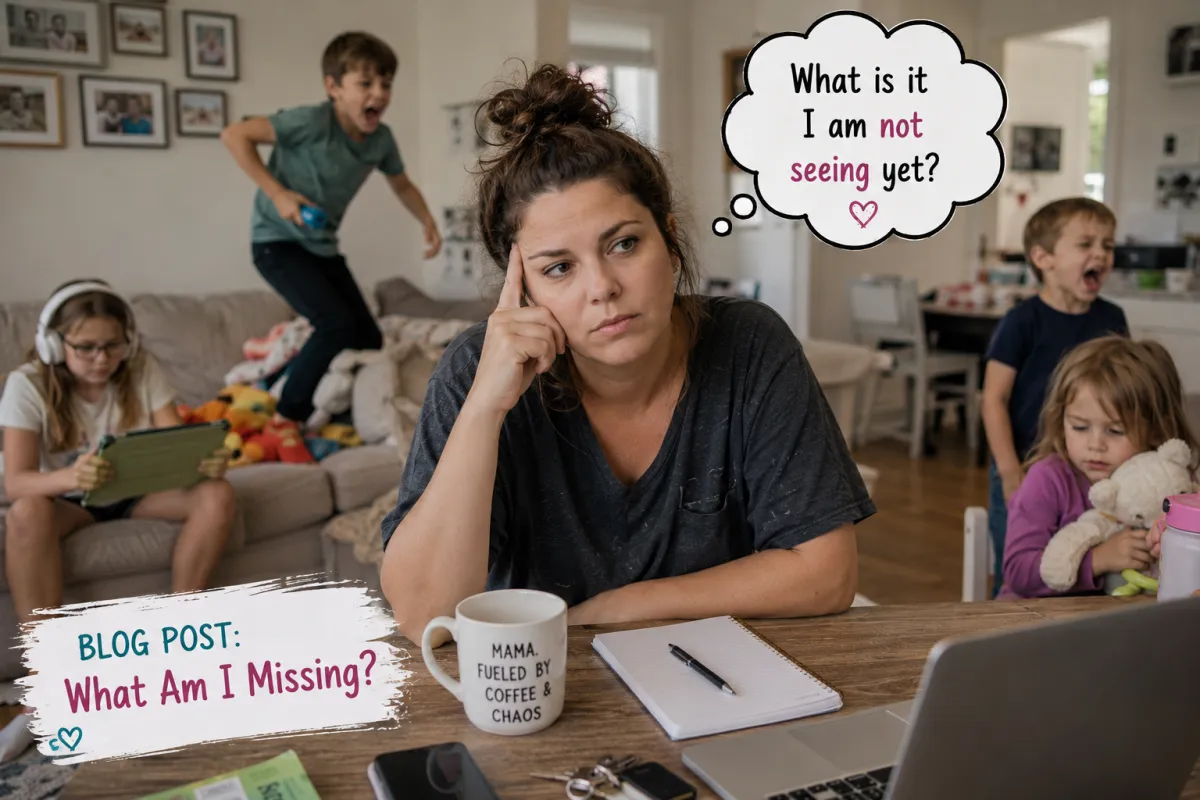
What Am I Missing?
What Am I Missing?
Few parenting questions carry as much weight as:
"What am I missing?"
It's the question that often appears after you've tried everything you know how to do.
You've listened to advice.
Read the books.
Adjusted your approach.
Had countless conversations.
And somehow the challenge remains.
At first, the question may feel like criticism directed at yourself.
As though you're overlooking something obvious.
You think to yourself "Surely, the world has come across something like this before?"
As though a better parent would already have the answer.
But from a TKC perspective, this question can be incredibly valuable.
Because it opens the door to curiosity.
And curiosity often leads to understanding.
And it's not because you are at fault,
It's because the system has halted everything based on old knowledge until now.
Why Parents Ask This Question
Most parents don't ask "What am I missing?" when things are going smoothly.
They ask it when patterns don't make sense.
When behaviour doesn't respond the way they expected.
When strategies that work for other families seem ineffective.
When the same challenges keep returning.
The question emerges because there's a gap between what we're seeing and what we're understanding.
And that gap is important.
Because behaviour rarely tells the entire story.
The Problem With Looking Only at What We Can See
Behaviour is highly visible.
It's loud.
It's disruptive.
It demands attention.
A child refusing.
Arguing.
Melting down.
Avoiding.
Shouting.
Withdrawing.
These are the parts everyone notices.
But behaviour is often the final outcome of multiple factors interacting together.
Life is not just one piece of pie, its the entire pie with all the ingredients made to create the pie turning out to resemble something like pie instead of soup.
When we focus only on what we can see, we risk missing the conditions that created the behaviour in the first place.
It's a little like seeing a warning light on a dashboard and spending all our energy trying to turn off the light.
The light is providing information.
The real question is what's happening underneath it.
What Most People Miss
Many parenting conversations focus on changing behaviour.
Far fewer focus on understanding behaviour.
This distinction matters.
Because behaviour is often connected to things that aren't immediately visible.
For example:
Anxiety may look like refusal.
Sensory overwhelm may look like defiance.
Fatigue from muscles that look the same but act differently may look like irritability.
Executive functioning challenges may look like forgetfulness or uncaring.
Emotional dysregulation may look like overreaction.
Communication difficulties may look like non-compliance.
The visible behaviour is only one piece of the puzzle.
Without understanding the rest of the picture, interventions can miss the mark.
The TKC Perspective
At TKC, we encourage parents to treat confusion as information.
If something doesn't make sense, that's often a sign there is more to learn.
Rather than asking:
"What's wrong?"
We ask:
"What might we not be looking at yet?"
This shift reduces blame and increases curiosity.
Instead of searching for fault, we begin searching for patterns.
And patterns often reveal important clues.
Because nobody is the problem.
The pattern is the problem.
Looking for Hidden Information
When you're feeling stuck, it can help to explore questions such as:
What happens before the behaviour?
Patterns often begin long before the behaviour becomes visible.
When does the behaviour not happen?
These moments can be just as informative as the difficult ones.
What seems difficult for the child?
Not what looks difficult from the outside.
What actually feels difficult from their perspective?
What need might be present?
Connection?
Predictability?
Recovery time?
Support?
Safety?
Understanding?
What skill might still be developing?
Emotional regulation?
Flexibility?
Communication?
Planning?
Transitioning between tasks?
Sometimes what looks like unwillingness is actually a skill still under construction.
A Practical Example
Imagine a child who regularly argues whenever it's time to leave the house.
The family has tried reminders.
Consequences.
Rewards.
Encouragement.
Nothing seems to work consistently.
The question naturally becomes:
"What am I missing?"
After observing more closely, they notice something interesting.
The arguments happen most often when plans change unexpectedly.
The child becomes distressed whenever they have to leave their favourite activity at short notice.
The issue isn't leaving the house.
The issue is the child had a plan, and it's not been expected to change.
Once the family understands this, their support changes.
They begin providing more notice.
Preparing for changes in advance.
Creating supports around transition times.
The pattern starts to make more sense.
Not because the child changed overnight.
Because hidden information became visible.
Curiosity Creates Better Questions
When parents feel stuck, it's tempting to look for bigger solutions.
Stronger consequences.
Better rewards.
More advice.
More strategies.
Sometimes what's needed isn't another solution.
It's a better question.
Questions like:
What am I noticing?
What keeps repeating?
What seems difficult?
What support might be needed?
What information haven't I considered yet?
These questions often lead us toward understanding rather than assumptions.
Summary
When parents ask:
"What am I missing?"
They're often standing at the edge of a breakthrough.
Not because they have failed.
But because they have recognised that there may be more to understand.
Behaviour is rarely the entire story.
Underneath it may be needs, skills, challenges, stressors, sensory experiences, emotions, or patterns that haven't yet been fully explored.
The goal isn't to find someone to blame.
The goal isn't to find a perfect strategy.
The goal is to uncover the information that helps the situation make sense.
Because once things make sense, meaningful support becomes much easier to provide.
And that journey often begins with a simple question:
"What am I not seeing?"
Not as a criticism.
But as an invitation to become curious.
Because nobody is the problem.
The pattern is the problem.