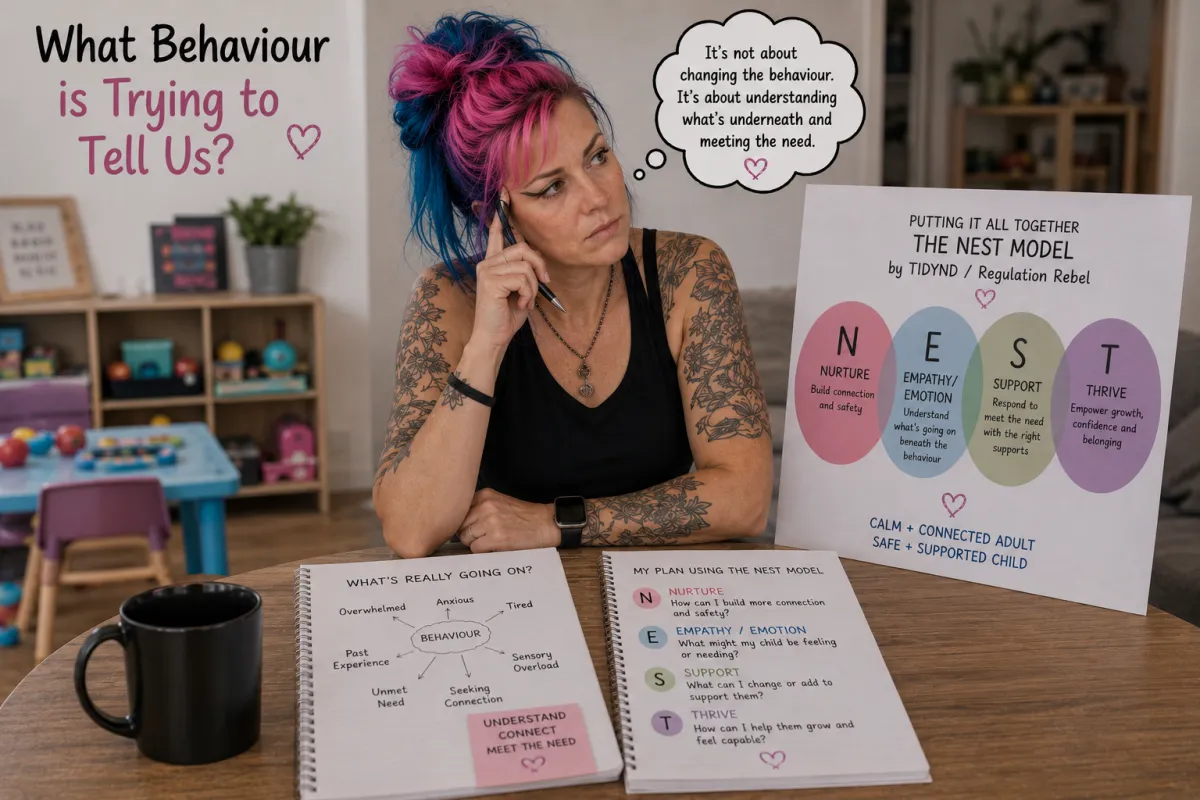
What Is Behaviour Trying to Tell Us?
What Is Behaviour Trying to Tell Us?
The Problem
Many parenting conversations start with behaviour.
"My child won't listen."
"They keep having meltdowns."
"They refuse to do simple things."
"They argue about everything."
"They shut down whenever something feels difficult."
When behaviour becomes challenging, frustrating, or disruptive, it's natural to want it to stop.
Most parenting advice focuses on changing behaviour.
How to reduce it.
How to manage it.
How to prevent it.
But sometimes parents find themselves working incredibly hard on the behaviour while seeing very little lasting change.
The same challenges continue to appear.
The same patterns repeat.
The same situations keep triggering the same responses.
This is often where frustration grows.
Not because parents aren't trying.
But because behaviour is rarely the whole story.
Why It Happens
Behaviour is what we can see.
Needs, emotions, stress, sensory experiences, uncertainty, anxiety, and skill gaps are often invisible.
Imagine behaviour as the warning light on a car dashboard.
The light itself isn't the problem.
It's alerting us that something underneath may need attention.
Children communicate in many ways.
Sometimes they use words.
Sometimes they use behaviour.
A child may not be able to explain:
"I'm overwhelmed."
"I don't know what to do."
"This feels too hard."
"I'm worried."
"I need help."
"My body doesn't feel regulated."
"I don't understand what's expected."
Instead, those experiences may show up through behaviour.
The behaviour becomes the visible clue.
Much like the symptoms of stress in adults.
It becomes the headache, the migraine,
The anxiety deep in our bellies.
What Most People Miss
One of the biggest misunderstandings about behaviour is assuming that behaviour itself tells us everything we need to know.
In reality, the same behaviour can have many different causes.
For example, a child refusing to start homework might be:
Feeling anxious about making mistakes
Struggling to understand the task
Mentally exhausted after a long day
Overwhelmed by too many instructions
Finding the work too difficult
Experiencing sensory discomfort
Unsure where to begin
The behaviour looks the same.
The reasons underneath can be completely different.
When we focus only on the visible behaviour, we risk solving the wrong problem.
And when we solve the wrong problem, the pattern often continues.
The TKC Perspective
At TKC, we often say:
Nobody is the problem. The pattern is the problem.
Behaviour is one of the most useful places to begin exploring patterns.
Not because behaviour is bad.
Not because behaviour needs fixing.
But because behaviour provides information.
The question shifts from:
"How do I stop this behaviour?"
to:
"What might this behaviour be telling me?"
This small shift creates a very different parenting experience.
Instead of immediately searching for consequences, rewards, or behaviour management strategies, we become investigators.
We gather clues.
We look for context.
We notice patterns.
We ask questions.
What happened before the behaviour?
When does it happen most often?
When does it happen less often?
What skills might be missing?
What needs might be going unmet?
The goal isn't to excuse behaviour.
The goal is to understand it.
Because understanding creates better solutions.
A Practical Example
Imagine a child who regularly becomes angry when it's time to leave the playground.
From the outside, it may look like they are simply refusing to cooperate.
The behaviour might include:
Arguing
Crying
Running away
Ignoring requests
Becoming physically upset
If we focus only on the behaviour, we may conclude that the child needs stronger consequences.
But curiosity opens other possibilities.
Perhaps transitions are difficult.
Perhaps they struggle when activities end unexpectedly.
Perhaps they need more warning before leaving.
Perhaps they feel disappointed but don't yet know how to express that feeling.
Perhaps shifting attention from one activity to another requires a skill they are still developing.
The behaviour is the clue.
The pattern underneath provides the direction.
Once we understand the pattern, we can teach skills, provide support, and create strategies that actually address the challenge.
Reflection Questions
The next time a behaviour catches your attention, consider asking:
What happened before this behaviour occurred?
What might my child be experiencing right now?
Is there a need, feeling, or challenge underneath this behaviour?
What skill might be difficult in this moment?
Does this behaviour happen in specific situations or environments?
What pattern am I noticing?
These questions help move us beyond reacting to the behaviour itself.
They help us understand the story underneath it.
Summary
Behaviour is often the part that gets our attention first.
It's visible.
It's immediate.
It's hard to ignore.
But behaviour is rarely the whole picture.
Children's behaviours can provide valuable clues about stress, emotions, unmet needs, uncertainty, sensory experiences, and skills that are still developing.
When we view behaviour as information rather than simply a problem to eliminate, we gain a deeper understanding of what support may be needed.
That doesn't mean every behaviour is acceptable.
Boundaries, safety, and expectations still matter.
But lasting change becomes more likely when we understand what the behaviour is communicating.
Because behaviour is often not the problem.
It's the clue.
And clues help us find the pattern.
Find out more here: The Kid Connection