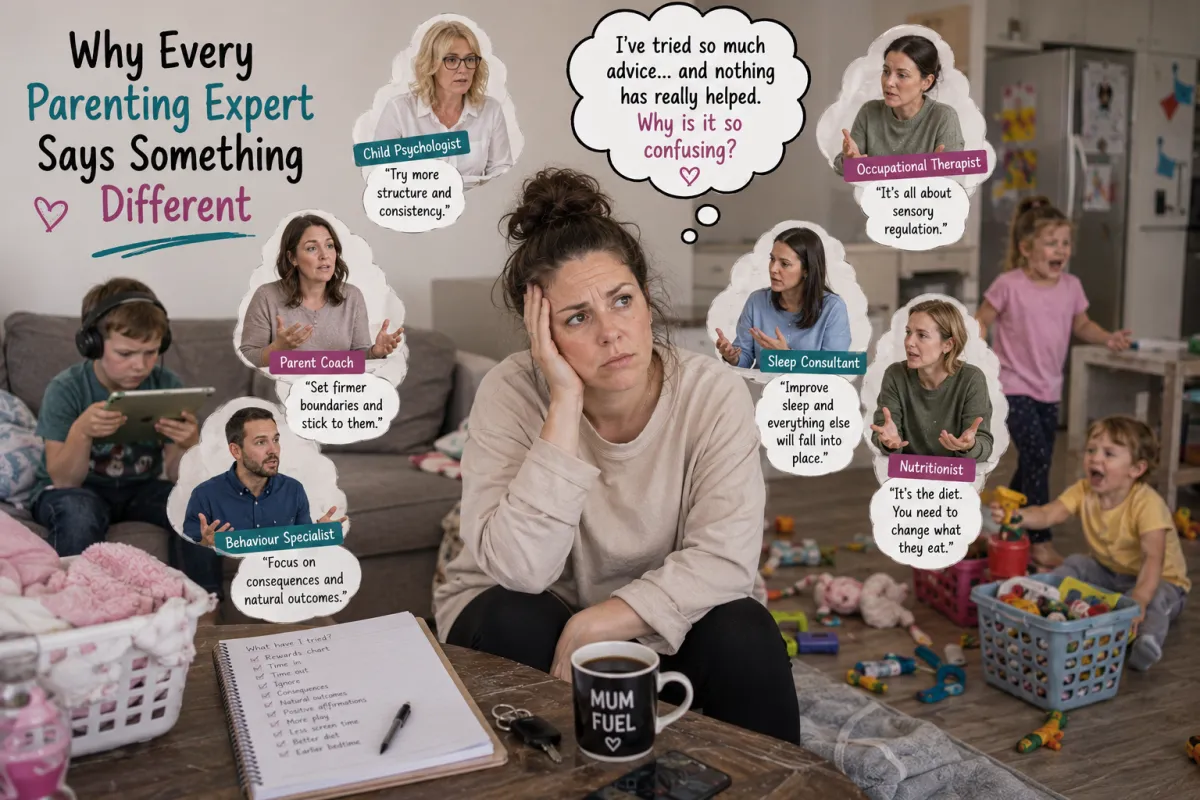
Why Every Parenting Expert Says Something Different
Why Every Parenting Expert Says Something Different
If you've ever searched for parenting advice online, you've probably experienced the same frustrating cycle.
You read one article and think:
"That makes complete sense."
Then you read another article that appears to say the exact opposite.
One expert encourages more of this and less of that.
Another extends your assumed capacity.
One says children need stronger boundaries.
Another says they need more connection.
One focuses on resilience.
Another focuses on input.
Eventually, many parents end up feeling stuck.
Not because they don't care.
Not because they aren't trying.
But because the advice feels impossible to reconcile.
So why does this happen?
Why do so many experts seem to disagree?
The Problem Isn't Usually the Advice
One of the biggest misunderstandings in parenting is the belief that there must be a single correct strategy for every situation, specifically through their unique lens.
If we assume there is one right answer, then every conflicting opinion feels like evidence that somebody must be wrong.
But children aren't maths equations.
Human behaviour is far more complex than that.
The reality is that many parenting experts are talking about different situations, different children, different needs, and different underlying causes.
Without context, advice can sound contradictory.
With context, it often becomes easier to understand.
Why Context Changes Everything
Imagine three children who all throw their school bag across the room after school.
The behaviour looks identical.
But the reasons behind it may be very different.
One child may be completely exhausted from masking all day.
Another may be enjoy the feeling of flinging something with with weight into the air (sensory input).
A third may be carrying anxiety about friendship issues that happened at school.
The behaviour is the same.
The context is different.
If we only focus on the behaviour itself, we may assume the same response should work for all three children.
But if the underlying need is different, the response may need to be different too.
This is where parenting advice often starts to diverge.
Different experts may be responding to different underlying causes, specifically in their unique field of expertise.
Making us parents frustrated, burnout, overwhelmed, doubtful and tired.
What Most People Miss
When parents hear conflicting advice, they often assume the disagreement is about parenting philosophy.
Sometimes it is.
But often it's because professionals are trained to look for different things.
A psychologist may be looking at anxiety.
An occupational therapist may be noticing sensory processing differences.
A speech pathologist may be identifying communication challenges.
A paediatrician may be considering developmental or medical factors.
You can't go to an Autism assessment and come out with an ADHD diagnosis, despite a lot of overlapping behaviours.
Each professional is observing the same child, but through the lens of their own area of expertise.
To make things even more complex, children don't always fit neatly into a single category.
A child may experience anxiety and autism.
ADHD and sensory processing challenges.
Communication difficulties and emotional regulation challenges.
Or several overlapping factors at the same time.
This can make assessment and support incredibly complicated.
Autism may just get ruled out completely, because the child does have it, but also has other contributing factors that come into play.
When multiple patterns exist simultaneously, it can be difficult for any one professional to confidently say, "This is the cause."
Instead, each specialist may be identifying one piece of a much larger puzzle.
This is one reason parents often receive recommendations that seem contradictory.
Different professionals may be responding to different aspects of the same child's experience.
They're not necessarily disagreeing.
They may simply be seeing different parts of the picture.
The Search for One Answer
Many parents enter the assessment process hoping for clarity.
And clarity is important.
Understanding a child's needs can be life-changing.
But sometimes the process is less like finding a single answer and more like uncovering layers that overlap so much, it's hard to pinpoint.
One assessment may identify anxiety.
Another may identify ADHD.
A third may highlight sensory differences.
A fourth may reveal communication challenges that have been present all along.
Parents can feel discouraged when this happens.
They may wonder why nobody noticed everything sooner.
Or why different professionals seem focused on different concerns.
The reality is that children are wonderfully complex.
Human development doesn't organise itself into tidy boxes.
Needs, traits, skills, experiences, and diagnoses often overlap and interact.
The goal isn't always to find the one explanation that makes everything make sense.
Sometimes the goal is to build a fuller picture over time.
And none help the child as they are.
None help you as the parent, manage your child as they are right now.
The TKC Perspective
At TKC, we don't start with the strategy.
We start with understanding.
Before asking:
"What should I do?"
We ask:
"What might be happening here?"
That doesn't mean boundaries aren't important.
It doesn't mean connection isn't important.
It doesn't mean skill-building isn't important.
All of those things can be valuable.
The challenge is knowing when and why they are needed.
At TKC, we encourage parents to step back and look at the whole child rather than searching for a single explanation.
Sometimes there isn't one answer.
Sometimes behaviour sits at the intersection of multiple needs, multiple challenges, and multiple experiences.
The goal is not always to pinpoint one perfect diagnosis, one perfect strategy, or one perfect explanation.
The goal is to understand the patterns well enough to make informed decisions about support.
Because when we expect a child's behaviour to have one simple cause, conflicting advice feels frustrating.
When we recognise that multiple factors may be interacting at the same time, the differing perspectives often start to make much more sense.
Nobody is the problem.
The pattern is the problem.
And patterns become easier to understand when we become curious about context.
A Practical Example
Imagine your child melts down every morning before school.
You ask for advice.
One person says:
"Be firmer and stop negotiating."
Another says:
"Slow the morning down and provide more support."
A third says:
"Create a visual schedule."
A fourth says:
"Check whether anxiety is playing a role."
Yet another says:
"Try some somatic healing exercises together"... like you aren't already bogged down in the thick of it.
At first glance, these suggestions may seem contradictory.
But each recommendation is based on a different explanation for the behaviour.
If the challenge is executive functioning, a visual schedule may help.
If the challenge is anxiety, predictability and emotional support may help.
If the challenge is sensory overwhelm, environmental adjustments may help.
And if several of these factors are present together, a combination of supports may be needed.
The key question isn't:
"Which expert is right?"
The key question is:
"Which explanation best fits the pattern I'm seeing?"
Leaving you wondering if you need to know it all in order to help.
Reflection Questions
The next time you encounter conflicting parenting advice, consider asking:
What assumptions is this advice making about the behaviour?
What might my child be experiencing that I cannot immediately see?
What patterns have I noticed over time?
Does this advice match the context of my family?
Could multiple factors be contributing at the same time?
What underlying need, challenge, or skill might be involved?
These questions often provide more clarity than trying to determine which expert has the "best" strategy.
Summary
Conflicting parenting advice can make parents feel like they're constantly getting it wrong.
But often, the disagreement isn't because one expert is correct and another is incorrect.
It's because behaviour can have many different causes.
The same behaviour can emerge from anxiety, overwhelm, sensory differences, lagging skills, communication challenges, executive functioning difficulties, unmet needs, transitions, stress, exhaustion, or a combination of several factors at once.
When we focus only on behaviour, advice feels contradictory.
When we focus on context, advice starts to make more sense.
Rather than searching for the one expert with all the answers, it can be more helpful to become curious about the pattern underneath the behaviour.
Because once we understand the pattern, we're no longer guessing.
We're making decisions based on understanding.