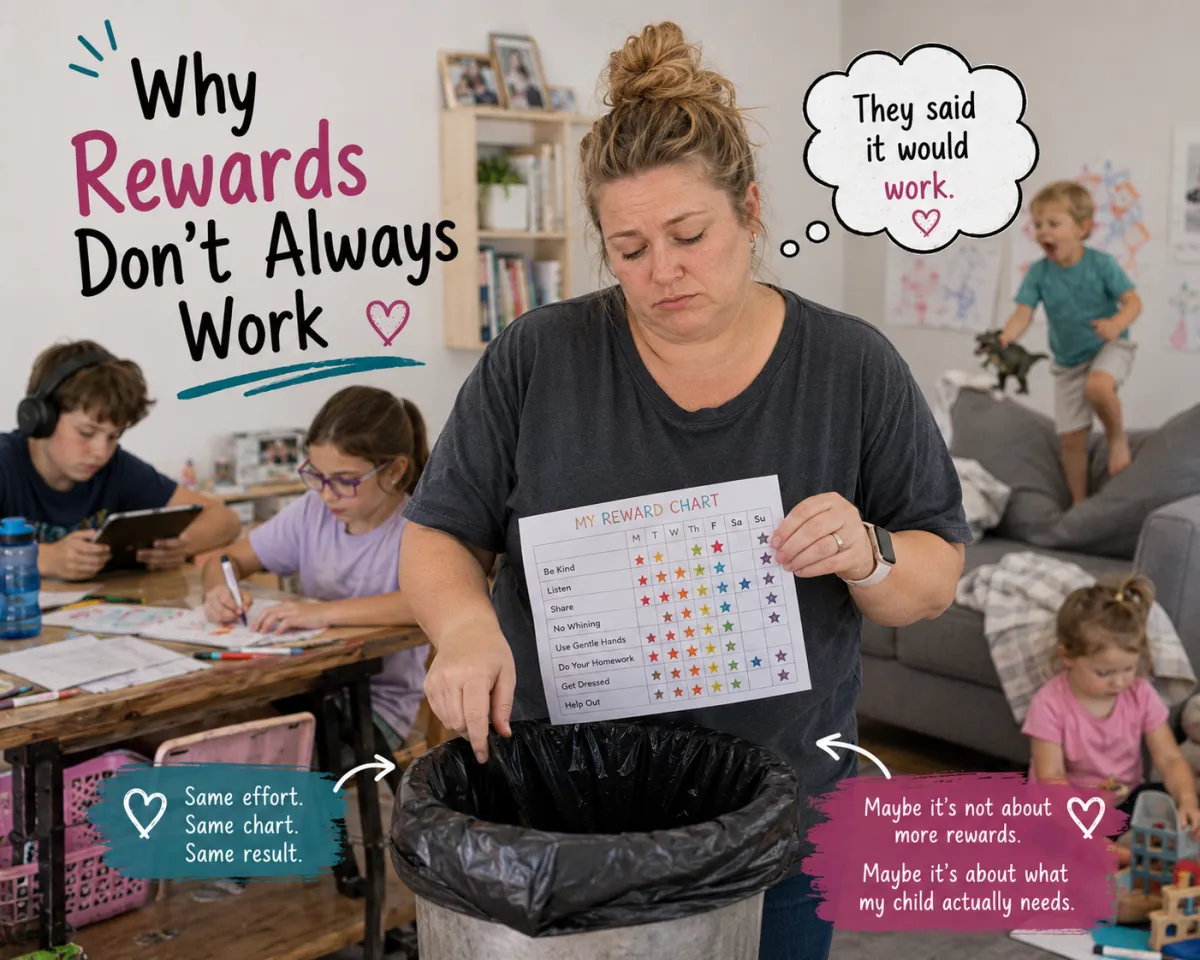
Why Rewards Don't Always Work
Why Rewards Don't Always Work
Rewards are one of the most widely recommended parenting tools.
Sticker charts.
Token systems.
Special treats.
Extra screen time.
Prize boxes.
The idea is simple.
A child does something desirable.
They receive a reward.
The behaviour increases.
And sometimes it works.
But many parents eventually encounter a frustrating reality.
The rewards are there.
The child wants them.
Yet the behaviour doesn't change.
Or the improvement is temporary.
Or the system works for one child and not another.
When this happens, parents often assume they need a bigger reward.
A more exciting reward.
A more consistent reward.
But often the real issue lies elsewhere.
The Assumption Behind Rewards
Rewards are built on an important assumption.
They assume the child is capable of doing the expected behaviour and simply needs additional motivation.
This can be effective when motivation truly is the missing ingredient.
For example, a child who forgets to feed a pet might become more consistent when a reward system is introduced.
But not all behaviour challenges are caused by low motivation.
Many are connected to capacity.
And capacity problems require a different approach.
Motivation and Capacity Are Not the Same Thing
Imagine offering someone a reward for reading a book written in a language they don't understand.
The reward may increase their desire to succeed.
But it doesn't increase their ability to read the language.
The barrier remains.
The same thing happens when children face challenges involving:
Emotional regulation
Sensory processing
Anxiety
Executive functioning
Communication
Flexibility
Social understanding
Transitions
Attention
Fatigue
A reward may increase motivation.
But it doesn't automatically remove the obstacle.
What Most People Miss
When rewards don't work, adults often focus on making the reward stronger.
The logic seems reasonable.
If a small reward doesn't motivate the child, perhaps a larger one will.
Sometimes this helps.
But if the child is already motivated and still struggling, increasing the reward may not change much at all.
In fact, many children desperately want to succeed.
They want the reward.
They want the praise.
They want things to go well.
They force themselves to do it the one time, but its not sustainable.
As they continue struggling, it is because the challenge sits somewhere other than motivation.
The TKC Perspective
At TKC, we often encourage parents to ask a different question.
Instead of:
"How can I motivate my child?"
We ask:
"What might be making success difficult?"
This question shifts our attention.
It moves us away from trying to increase effort and toward understanding barriers.
Because if a child is already trying hard, adding more motivation may not solve the problem.
Understanding the obstacle often provides more useful information.
A Practical Example
Imagine a child who struggles every morning when it's time to leave for school.
A reward chart is introduced.
Each successful morning earns a sticker.
Five stickers earn a prize.
The child is excited.
They want the reward.
Yet the morning struggles continue.
At first glance, it appears the reward isn't motivating enough.
But a closer look reveals something different.
The child struggles with transitions.
Moving from one activity to another feels difficult.
Unexpected changes increase stress.
The morning routine contains multiple transitions in a short period of time.
The problem isn't that the child doesn't care.
The problem is that the transition itself is hard.
Once the family understands this, they begin supporting transition skills rather than focusing only on rewards.
Visual schedules are added.
Preparation increases.
Warnings are given before changes occur.
The pattern improves.
Not because motivation increased.
Because the underlying challenge was addressed.
Rewards Have Limits
This doesn't mean rewards are harmful or should never be used.
Rewards can be useful.
They can encourage practice.
They can support habit-building.
They can make expectations clearer.
But rewards are tools.
And tools work best when matched to the problem.
A hammer is useful for nails.
Less useful for tightening a screw.
Similarly, rewards can help with motivation.
They are often less effective when behaviour is being driven by overwhelm, anxiety, sensory challenges, or missing skills.
Reflection Questions
When a reward system isn't producing the results you hoped for, consider:
Does my child already want to succeed?
What happens right before the behaviour?
Could there be anxiety involved?
Is sensory overwhelm a factor?
Does my child have the skills needed for this situation?
Is the challenge about motivation or capacity?
What support might reduce the barrier?
These questions can reveal information that rewards alone cannot.
Summary
Rewards can be valuable tools.
But they are not universal solutions.
They work best when the primary challenge is motivation.
When behaviour is influenced by anxiety, sensory differences, emotional regulation challenges, executive functioning difficulties, or lagging skills, rewards may have limited impact.
This doesn't mean the child doesn't care.
It doesn't mean they're being difficult.
And it doesn't mean you need a bigger prize.
Sometimes the most important question isn't:
"What reward will make this happen?"
It's:
"What is making this difficult in the first place?"
Because when we understand the barrier underneath the behaviour, we can offer support that actually matches the need.
And that's where lasting change is often found.
Nobody is the problem.
The pattern is the problem.