Why So Much Neurodivergence Education Feels Disconnected From Lived Experience
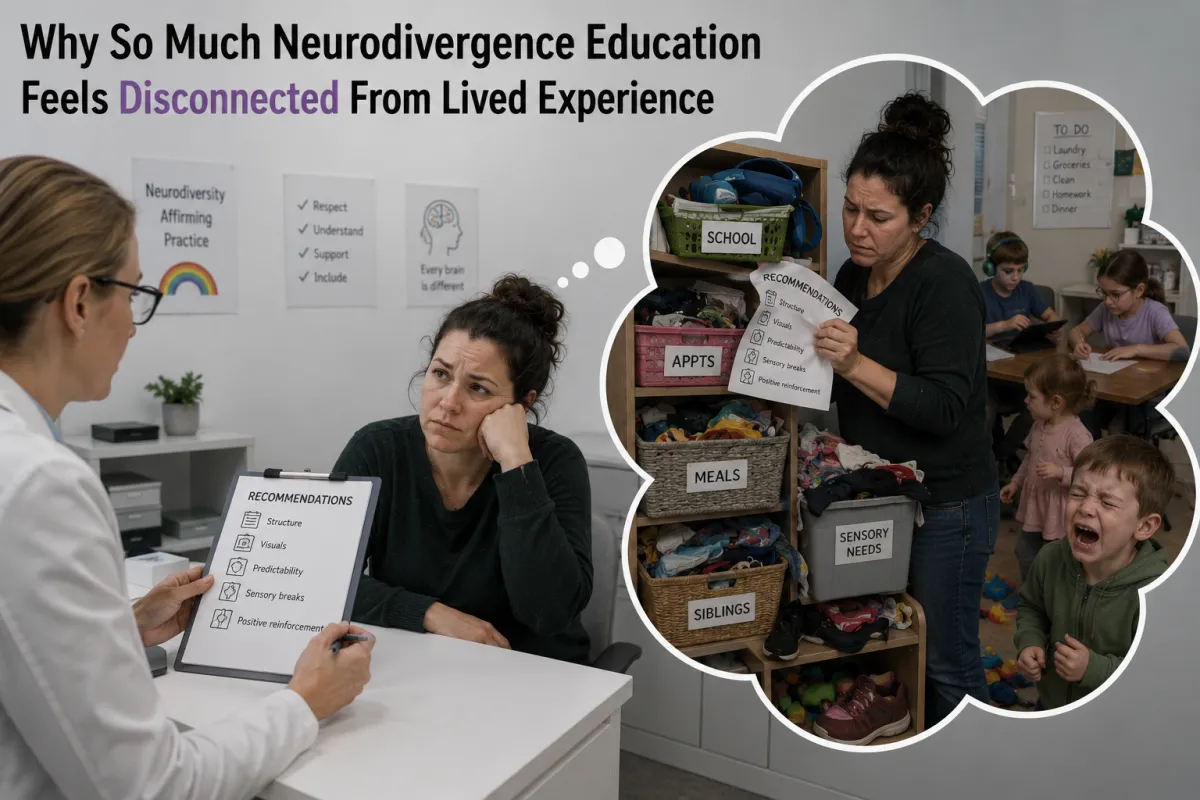
Why So Much Neurodivergence Education Feels Disconnected From Lived Experience
To fully understand modern conversations around ADHD, autism, and neurodivergence, we need to look beyond surface-level education models and examine where the original frameworks came from.
Because the reality is: much of what is considered “standard” knowledge around neurodivergence was built within systems that were never designed with neurodivergent lived experience at the centre.
The education system, psychology field, medical model, and broader societal structures all influence how neurodivergence has been researched, defined, and taught. These systems were largely shaped within rigid institutional frameworks that often valued compliance, productivity, and standardisation over individual neurological differences.
That history matters.
It helps explain why so many neurodivergent people sit through training, therapy, schooling, or support services and leave feeling unseen — even when the professionals involved are highly educated.
My Perspective Is Both Professional and Lived
I approach this work differently because I don’t only engage with neurodivergence academically.
I live it.
As someone with both ADHD and autism, I naturally research deeply across interconnected subjects — including history, education, psychology, systems theory, and societal structures — because none of these areas exist in isolation. They all shape how we understand human behaviour and neurological difference.
That gives me a perspective that combines formal training with lived experience.
And honestly, that distinction matters.
Because while I do have formal education in this field, much of the training itself felt deeply disconnected from the reality of neurodivergent experience. It often approached the brain in rigid, linear ways, despite the fact that human neurobiology is anything but rigid or linear.
The more I learned, the more I noticed the gap between institutional knowledge and real-world lived experience.
The Problem With Segmented Thinking
One of the biggest limitations within traditional systems is the tendency to separate human experiences into neat categories.
But neurodivergence rarely works that way.
People can be highly intelligent and deeply struggling at the same time.
Someone can thrive in one environment and completely dysulate in another.
A person can be autistic and ADHD.
Capable and unsupported.
High masking and overwhelmed.
Multiple truths can exist simultaneously.
And this is one of the major limitations of the medical system as it currently stands — many diagnostic and support frameworks are not built to fully recognise overlapping, layered experiences happening at the same time. Systems often seek singular explanations, clear categories, and linear presentations, when real neurodivergent experiences are far more complex than that.
As a result, many people are misunderstood, missed entirely, misdiagnosed, or supported in ways that don’t actually reflect their lived reality.
Yet human neurobiology is rarely singular or straightforward. Context, environment, nervous system state, trauma, sensory load, masking, personality, and co-occurring neurotypes can all interact simultaneously and shape how someone experiences the world.
This is where many neurodivergent people feel unseen — because lived experience is often far more nuanced than the frameworks designed to assess and support it.
Why Lived Experience Matters
Lived experience does not replace education or research.
But it adds something essential that theory alone cannot provide: embodied understanding.
When lived experience and professional knowledge are combined, it becomes easier to recognise patterns that rigid systems may overlook. It also creates space for more flexible, compassionate, and realistic approaches to support.
That is the foundation of my work.
Not just academic theory.
Not just personal experience in isolation.
Not just autism.
Or ADHD.
Or trauma.
Or giftedness.
Or sensory processing differences.
Or nervous system dysregulation.
Or burnout.
Or anxiety.
Or the effects on mental health.
Or the impact of chronic masking and survival-based adaptation.
None of this in isolation.
Because for many neurodivergent people, these experiences do not exist separately.
They overlap.
They influence one another.
They can amplify each other, mask each other, contradict each other, and exist simultaneously within the same person.
This is where many traditional systems struggle — because they are often designed to separate people into categories rather than understand the complexity of interconnected neurobiology and lived experience.
And lived experience does.