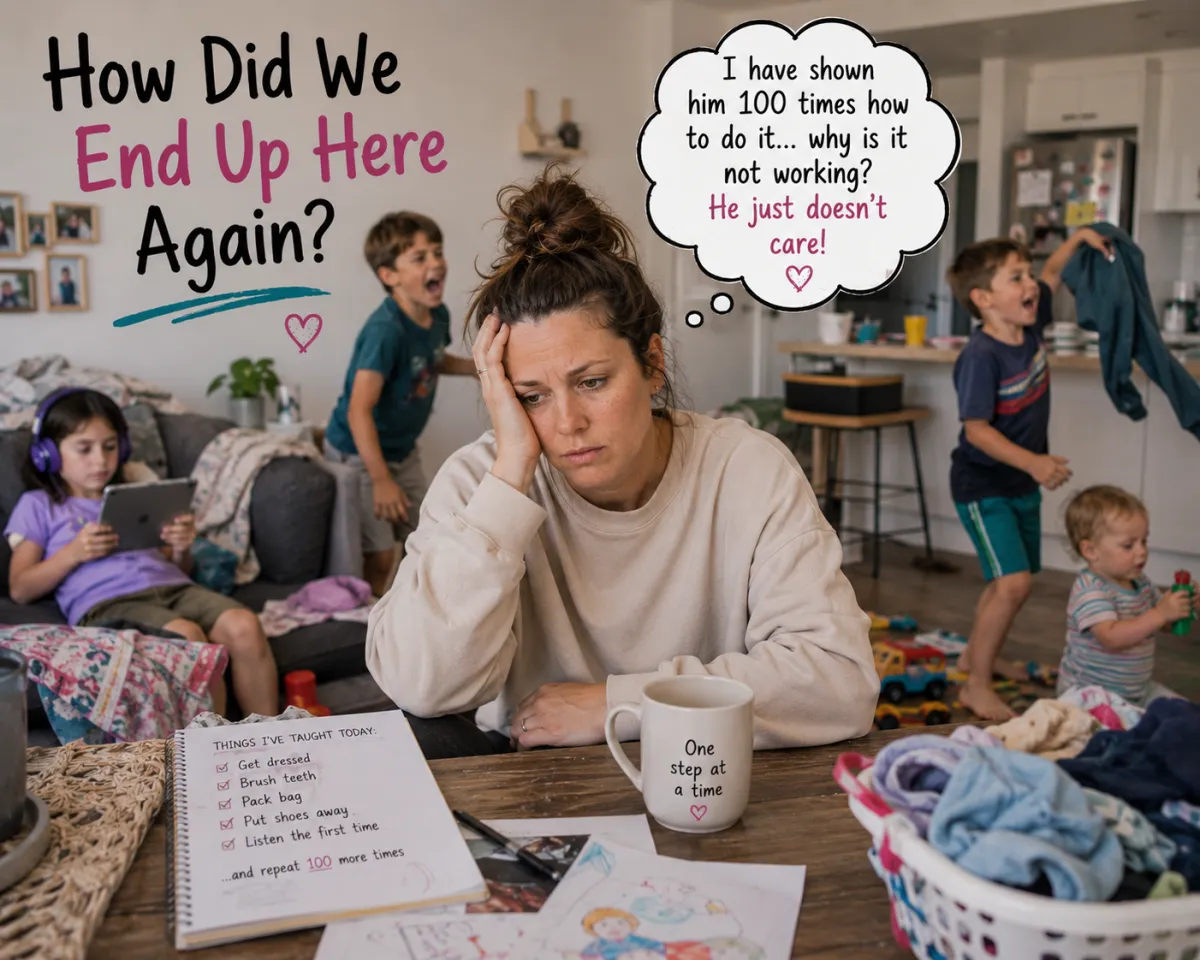
How Did We End Up Here Again?
How Did We End Up Here Again?
There are moments in parenting that feel strangely familiar.
The same disagreement.
The same school struggle.
The same bedtime battle.
The same emotional reaction.
And somewhere in the middle of it all comes the question:
"How did we end up here again?"
It's a question often filled with frustration, exhaustion, and disappointment.
Especially when you've already invested time, energy, and effort trying to make things better.
You thought you'd moved past this.
You thought the problem was solved.
Yet here it is again.
But what if returning to a challenge doesn't mean you've gone backwards?
What if it's an invitation to understand the pattern more deeply?
Why Repeated Challenges Feel So Defeating
When a struggle returns, many parents interpret it as evidence that nothing worked.
The thinking often sounds like this:
We already dealt with this.
We talked about this.
We had a plan.
Things were improving.
So when the challenge reappears, it feels like failure.
But human development rarely follows a straight line.
Children learn, grow, practise, forget, struggle, recover, and learn again.
Progress is often much messier than we expect.
A recurring challenge doesn't automatically erase the progress that happened before it.
Patterns Tend to Return for a Reason
Repeated patterns usually aren't random.
They often persist because something important remains unresolved.
This doesn't mean a parent has missed something obvious.
It simply means there may still be information to uncover.
For example:
A child may still be developing a skill.
An environment may still be creating stress.
An expectation may still exceed capacity.
A need may still be going unmet.
They may be processing things from a while ago
A challenge may still be present beneath the surface.
They might be trying to wrap their head around it
When these conditions remain, the pattern often returns.
The behaviour is simply the visible part of a much larger system.
What Most People Miss
When a difficult moment occurs, attention naturally focuses on the incident itself.
The argument.
The refusal.
The meltdown.
The conflict.
But individual incidents rarely tell the whole story.
Imagine watching a single frame from a movie.
You would see what happened in that moment, but you would miss everything that led up to it.
Parenting challenges are similar.
The behaviour often makes more sense when viewed as part of a larger pattern.
That's why looking at context is so important.
The TKC Perspective
At TKC, we encourage families to step back and observe the pattern rather than becoming trapped inside the latest event.
Instead of asking:
"Why did this happen again?"
We ask:
"What keeps leading up to the conditions for this pattern they are in?"
This question shifts our attention.
We stop searching for someone to blame.
We stop assuming the latest behaviour tells the whole story.
We start becoming investigators.
And investigators gather information.
They look for clues.
They look for repetition.
They look for relationships between events.
Because understanding the pattern often reveals opportunities for change.
A Practical Example
Imagine a child who regularly struggles with homework.
Every few weeks, things improve.
The family feels hopeful.
Then the difficulties return.
The immediate conclusion might be:
"We're back at the beginning."
But a closer look reveals something different.
The child manages homework well when tasks are familiar and predictable.
The struggles return when assignments become more complex or less structured.
The problem isn't that the child forgot everything.
The problem is that the demands changed.
The underlying challenge is still present.
Once the family understands this, their focus shifts.
Instead of repeatedly addressing the visible behaviour, they begin supporting the skills needed for planning, organisation, and task initiation.
The pattern starts making sense.
Progress Doesn't Always Look Like What We Expect
One of the biggest misconceptions in parenting is the belief that progress should eliminate future struggles.
Real progress often looks different.
A child may recover more quickly.
Need less support.
Communicate their needs more clearly.
Show improvement in some situations but not others.
Handle challenges successfully nine times and struggle on the tenth.
Because the tenth might have been a more pressure-loaded day.
These changes matter.
Even when the original pattern occasionally reappears.
Growth is rarely perfect.
And it rarely happens in a straight line.
Reflection Questions
The next time you find yourself asking, "How did we end up here again?", consider these questions:
What exactly keeps repeating?
When does this pattern occur?
What seems to happen before it?
What conditions make it more likely?
What conditions make it less likely?
What skill might still be developing?
What need might still be present?
These questions often reveal valuable information.
Summary
When parenting challenges return, it's easy to assume you're back where you started.
But repeated patterns are not always signs of failure.
Often, they are signs that there is more to understand.
A skill still developing.
A need still present.
An environment still creating difficulty.
A challenge still waiting to be recognised.
The goal is not to eliminate every struggle immediately.
The goal is to understand the pattern clearly enough to respond effectively.
So the next time you find yourself wondering:
"How did we end up here again?"
Remember that the question itself contains an opportunity.
Because every recurring pattern has something to teach us.
And when we understand the pattern, we move closer to meaningful change.
Nobody is the problem.
The pattern is the problem.