ND Families - Our Invisible Barrier
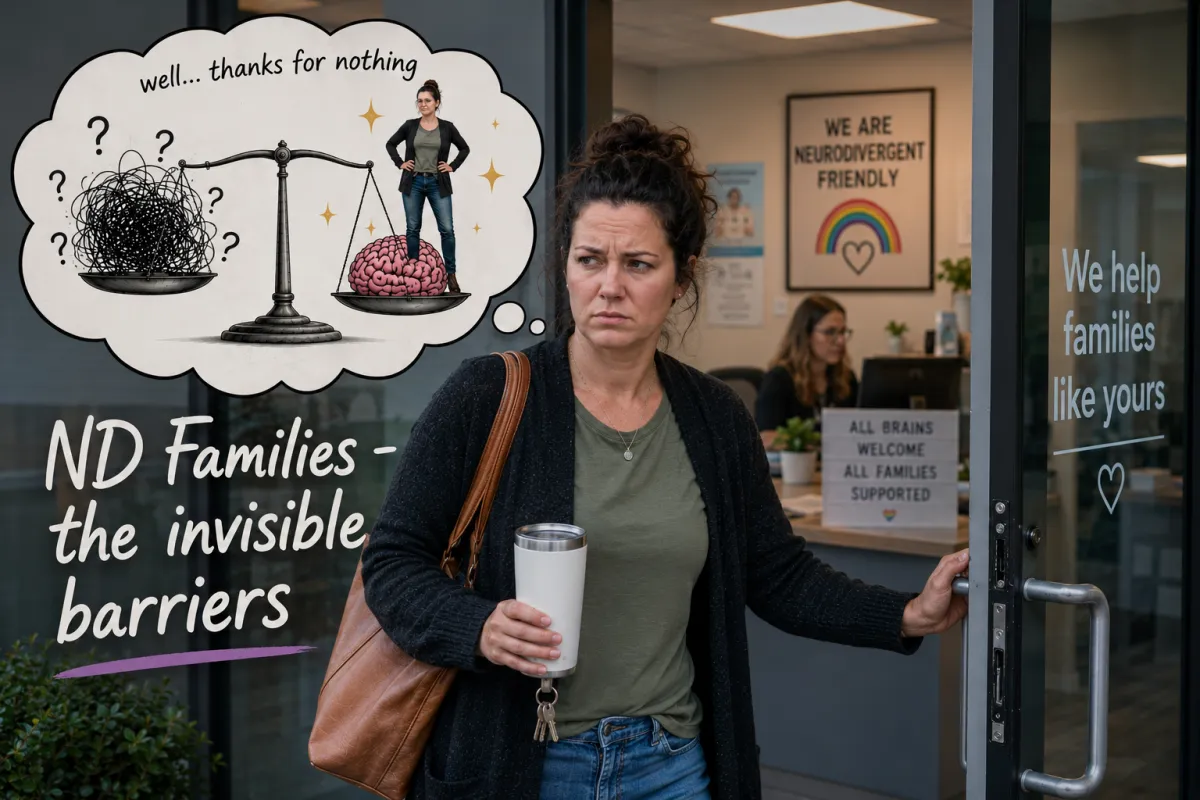
“You Seem Capable” — The Invisible Barrier Neurodiverse Families Face
One of the most painful realities for many neurodiverse families is this:
people only believe struggle when they can visibly see collapse.
If you are speak your need directly…
If you show up managed…
If you ask specifically for what you need …
If you manage to function externally…
people assume you are coping. And coping well.
And that assumption becomes a barrier to help.
“You seem capable.” "You present well." "You shouldn't have any problem."
What a SLAM in the face.
Those three words have blocked support for countless neurodiverse people.
Housing support.
Disability services.
Carer support.
Mental health support.
Emergency assistance.
Not because the need was not real.
But because the distress did not look the way people expected.
What People Call “Capable” Is Often Masking
This is something many autistic and neurodiverse people understand deeply.
What the outside world sees as:
organised
articulate
high-functioning
capable
put together
…is often an extremely delicate balancing act happening behind the scenes.
Not because life feels manageable.
But because the alternative feels dangerous.
Many of us are not masking to impress people.
We are not “faking it til we make it.”
We are not trying to appear perfect.
We are trying to survive. Simply making our way through life as best we can.
We are carefully managing our nervous systems to avoid spiralling into complete burnout, shutdown, depression, overwhelm, or collapse.
That is not ease.
That is active regulation work happening every single day.
And honestly?
It is exhausting.
“But You Don’t Look Like You’re Drowning”
This is where the misunderstanding becomes devastating.
Neurodiverse people will often verbally say:
“I need help.”
Clearly.
Directly.
Honestly.
And yet people still respond to the appearance instead of the words.
Because externally:
you still showed up - because if you don't, you don't get help. But if you do, it's becuase your nervous system is running wild and you're kicking yourself to get there "on time".
you still answered emails - because you know yourself. If you don't do it now, it won't get done. That is not efficiency or ease. That's a stress response.
you still looked presentable - maybe this is one of the ways you care for your mental health.
you still sounded intelligent - you know what you want - then they assume you can also have the capacity to find and maintain it - while you struggle with Executive Functioning skills....
you still managed the basics - because you have learnt that is the basics of self care on a bad day. Not because you are coping and it's easy. It's a mental struggle to get yourself to show up for yourself each day.
So people assume:
“If they were really struggling, they wouldn’t be able to do those things.”
But that completely misses what masking actually is.
Masking is often the reason we can still do those things.
Not because things are easy…
…but because we are pouring enormous amounts of energy into staying barely afloat.
The balancing act itself is the thing we are asking help for.
That is the part people do not see.
Neurodiverse People Often Learn to Self-Manage Because We Have To
Many autistic and neurodiverse people become experts at avoiding what I call:
“the spiral.”
The dark spiral of burnout.
Shutdown.
Mental collapse.
Complete overwhelm.
Depression.
Shame.
Fear.
So we cope by learn our warning signs.
We learn ourselves.
We micromanage our energy levels (our spoons for the day).
We structure our environment carefully, catering to our own needs.
We hold ourselves together with our own capabilities, recovery timeframes, sensory management, and constant mental calculations.
Not because we are thriving.
Because we know what happens if we stop.
And when support systems look at that effort and say:
“Well you seem capable…”
they completely misunderstand what they are literally being told.
They are seeing survival strategies.
Not ease.
And their assumptions are devastating to those of us who DIRECTLY ask for our needs to be met.
The Worst Advice I Ever Received
One of the most heartbreaking things I have been told while trying to access help was this:
“Maybe you need to look less put together.”
“Wear daggier clothes.”
“Act like you’re coping less.”
“Play dead a bit.” (ok well that last one is exaggerated a little)
And honestly?
That advice completely fails autistic people.
Because many of us cannot perform distress on command.
I cannot pretend to be someone I am not.
I cannot strategically “look worse” to deserve support. Mentally that doesn't fly with me.
I cannot fake helplessness just to satisfy somebody else’s idea of struggle because they are unable or unwilling to hear what I am saying.
Even when I am exhausted, overwhelmed, and barely holding things together…
I still try to present in ways that help me avoid spiralling further.
That is part of how I regulate.
Wearing clothes that feel good.
Keeping some structure.
Maintaining parts of myself.
Not because I am fine.
Because I am actively trying to stay out of the hole.
And no — that should not disqualify someone from receiving help.
And I thought next time I encounter this scenario - I am going to call it out -
"so hold on, I am directly asking for help to get my needs met and because I regulate myself in my environment 'well enough' you assume I am doing well - despite the words I am saying to you?"
.... and likely - they'll get offended. In which case - request the manager and be like "I ma here for help, and this person is being biased based on their assumptions of my life - not the information I am telling them."
Then they can go eat a frog. (And by that I mean ... well - let's keep it polite).
This Is Why So Many ND Mums Feel Invisible
So many struggling neurodiverse mothers are not failing because they are lazy, incapable, or “not trying hard enough.”
They are exhausted because they are carrying invisible loads while constantly being told:
“You seem fine.”
They ask for help.
They explain the overwhelm.
They explain the mental load.
They explain the exhaustion.
And still…
people respond to the mask instead of the words.
Over time, many ND mums internalise this message:
“If I am not visibly falling apart, I must not deserve support.”
This is why when we finally do fall apart - we feel deep shame because suddenly the outside world changes their tune "why didn't you ask for help sooner?"
That is a lie. We did, and we mentally sacrificed so much to be let down - again on repeat that we stop asking. We drown in our worlds, get consumed and burnt out. Until it physically hurts with an unexplainable pain.
And honestly?
It is a deeply dangerous one.
This Topic Became My Passion Project
Over my lifetime, I realised something important:
Neurodiverse families do not struggle because they suck at life.
They struggle because the systems around them often fail to recognise invisible nervous system load until complete collapse happens.
And I refuse to accept that anymore.
That is why I created TIDY ND.
Not as another “perfect parenting” system.
Not as another unrealistic productivity method.
But as a practical, nervous-system-aware approach built from lived experience.
A system designed for real neurodiverse homes.
Homes where people are already trying unbelievably hard.
Homes where survival strategies are often mistaken for capability.
Homes where tiny sustainable steps matter more than perfection ever will.
This is not about magically fixing life overnight.
It is about creating systems that actually support neurodiverse nervous systems instead of fighting against them.
Systems with:
flexibility
fall-back plans
recovery built in
realistic expectations
baby steps forward
compassion instead of shame
Not perfectly.
But effectively.
And in a way that helps people stay out of the spiral instead of constantly falling back into it.
Because neurodiverse people should not have to completely break publicly before they are finally considered worthy of support.
Want to hear more?
Join my mailing list! https://tidynd.com/nestnews