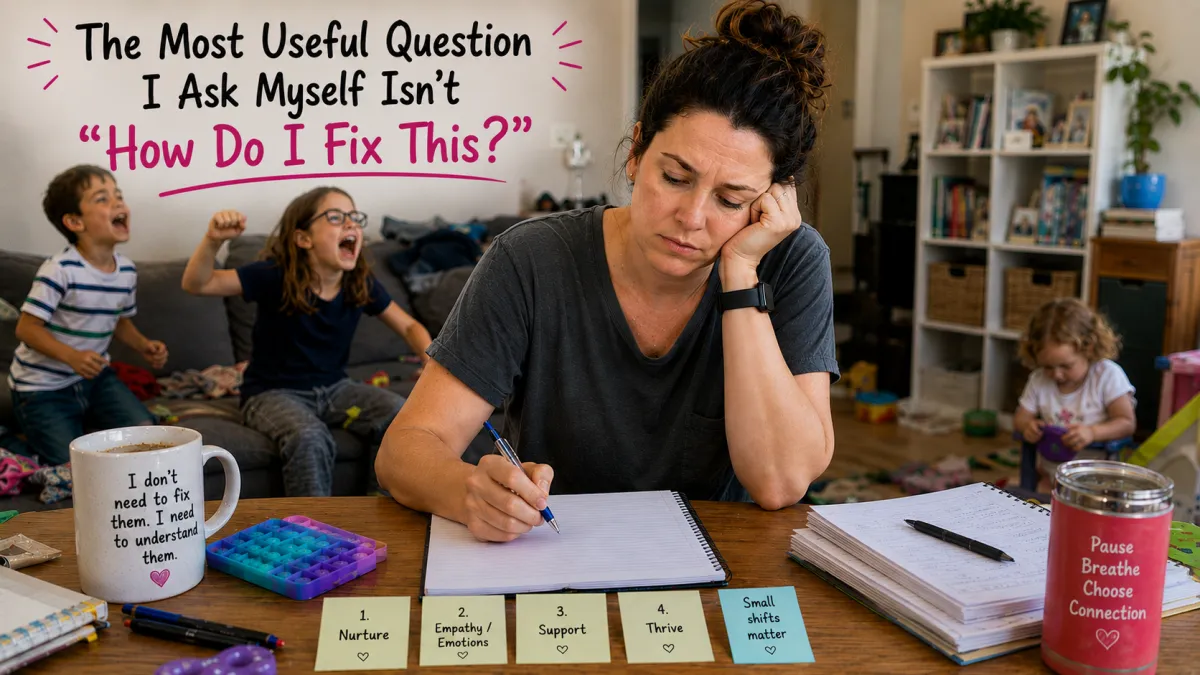
The Most Useful Question I Ask Myself Isn't "How Do I Fix This?"
The Most Useful Question I Ask Myself Isn't "How Do I Fix This?"
I've noticed something interesting.
Most parenting, regulation, and self-development advice starts with behaviour.
What behaviour needs to change?
What response should I use?
What skill should I build?
What strategy should I try?
But lately I've been asking a different question.
One that works in the middle of chaos.
One that doesn't require a quiet house.
Or more sleep.
Or a supportive partner.
Or compliant children.
Or a perfectly regulated nervous system.
It can be asked while someone is screaming from another room.
While one child is melting down.
While another is processing grief.
While dinner is burning.
While your brain is overloaded.
The question is:
What scarcity belief just got activated?
Because Behaviour Is Usually Protecting Something
When I become reactive...
What am I afraid is running out? What are THEY afraid is running out?
Patience?
Time?
Energy?
Control?
Hope?
Money?
Connection?
Love?
Safety?
Certainty?
Most behaviours make more sense when we understand the scarcity underneath them.
The snapping.
The rescuing.
The over-explaining.
The controlling.
The withdrawing.
The spiralling.
The fixing.
Often those behaviours are attempts to manage a perceived shortage.
A nervous system responding to scarcity.
A Different Starting Point
Many approaches begin with:
"What behaviour do I need to change?"
But behaviour is often the final expression of something much deeper.
What if the more important question is:
What belief is driving this behaviour?
Because if I believe patience is running out, I'll parent differently.
If I believe money is running out, I'll make decisions differently.
If I believe support is running out, I'll respond differently.
If I believe love is conditional, I'll relate differently.
The behaviour isn't appearing from nowhere.
It's growing from a belief about what is available to me.
Or what isn't.
The Role Of Trusting
For me, this is where trusting the outcome enters the conversation.
Not as a coping strategy.
Not as positive thinking.
Not as denial.
But as a framework.
A way of interpreting reality.
Because if I start with the assumption that there is hope and it exists, then I am also invited to question whether scarcity is telling the truth.
I become more willing to ask:
Is patience actually running out?
Is provision actually running out?
Is wisdom actually unavailable?
Is support completely absent?
Is hope gone?
Or has my nervous system become convinced that I am alone?
The question doesn't magically remove hard circumstances.
The bills still exist.
The grief still exists.
The exhaustion still exists.
The parenting challenges still exist.
But it changes where I look for answers.
Sometimes this looks like turning to a higher power or God.
And to some, its trusting the outcome. Knowing everything works out in the end.
The Question That Fits Inside Real Life
What I love most about this question is its practicality.
It doesn't require ideal conditions.
It doesn't require me to be calm first.
It doesn't require me to solve the situation before I can use it.
I can ask it while my heart is racing.
While my child is dysregulated.
While my brain is convinced everything is too much.
What scarcity belief just got activated?
Because that question often takes me closer to the real issue than:
"How do I make this stop?"
The first question leads to awareness.
The second often leads to panic.
Maybe That's Where Change Starts
Not with fixing behaviour.
Not with finding the perfect script.
Not with trying harder.
But by noticing the story underneath the reaction.
The belief underneath the behaviour.
The scarcity underneath the struggle.
Because when we can see the belief clearly, we finally have something real to work with.
And sometimes that belief has been quietly running our lives for years.
Need some support around this? Join my weekly newsletter drop!