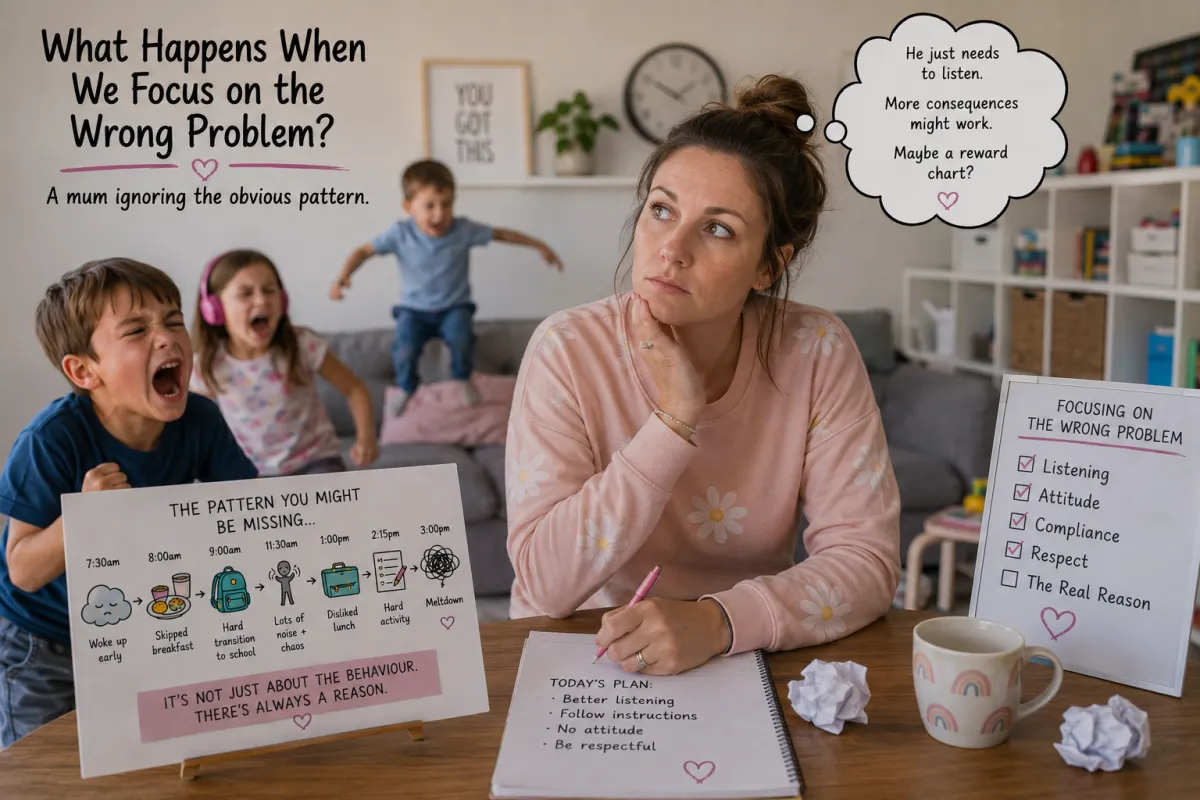
What Happens When We Focus on the Wrong Problem?
What Happens When We Focus on the Wrong Problem?
The Problem
Few things are more frustrating for parents than working hard to solve a challenge and seeing little change.
You try different strategies.
You read articles.
You follow advice.
You stay consistent.
Yet the behaviour keeps returning.
The morning battles continue.
The school refusal continues.
The sibling conflict continues.
The meltdowns continue.
It's easy to conclude that the child isn't responding, the strategy isn't working, or you're somehow getting it wrong.
But there is another possibility.
You may be focusing on the wrong problem.
Not because you've done anything wrong.
But because behaviour can sometimes disguise the real challenge sitting underneath it.
Why It Happens
Most of us naturally focus on what we can see.
Behaviour is visible.
It's measurable.
It's immediate.
When a child refuses, argues, avoids, or melts down, the behaviour becomes the centre of attention.
The challenge is that behaviour is often the outcome of a deeper process.
It's the result, not always the cause.
Imagine seeing a plant with yellow leaves.
You could spend your time painting the leaves green.
From a distance, the plant might look healthier.
But if the roots aren't getting what they need, the problem remains.
Behaviour can work in much the same way.
The visible behaviour may be drawing attention to something deeper that requires understanding.
What Most People Miss
One of the biggest traps in parenting is assuming that the most visible problem is the most important problem.
But visible and important are not always the same thing.
Consider a child who regularly avoids school.
The visible problem is school refusal.
But school refusal itself is not an explanation.
It is a behaviour.
The question becomes:
What is making school feel difficult?
Possible answers could include:
Anxiety
Sensory overload
Social challenges
Learning difficulties
Exhaustion
Uncertainty
Fear of making mistakes
If we focus exclusively on attendance, we may miss the factors driving the avoidance.
And when the underlying challenge remains unchanged, the behaviour often continues.
The TKC Perspective
At TKC, we encourage parents to become investigators rather than problem eliminators.
When behaviour appears, our first task isn't necessarily to stop it.
Our first task is to understand it.
That doesn't mean ignoring behaviour.
It means recognising that behaviour may be pointing towards something else.
A useful way to think about this is:
Behaviour is often the address, not the destination.
It tells us where to start looking.
It rarely tells us the full story.
When we focus only on the behaviour, we risk solving the symptom.
When we explore the pattern underneath, we move closer to solving the actual challenge.
This shift changes the questions we ask.
Instead of:
How do I stop this?
How do I make this go away?
How do I get compliance?
We begin asking:
What is driving this?
What challenge is sitting underneath?
What need, stressor, or skill gap might be involved?
What would need to be true for this behaviour to make sense?
These questions lead us towards understanding rather than assumptions.
A Practical Example
Imagine a child who regularly explodes when asked to stop playing and come to dinner.
The visible problem is the outburst.
The natural response might be to focus entirely on stopping the reaction.
But what if we explored the pattern instead?
Perhaps transitions are difficult.
Perhaps the child struggles shifting attention.
Perhaps they need more preparation before activities end.
Perhaps they experience strong disappointment and don't yet have the skills to manage that feeling.
The behaviour hasn't changed.
But our understanding has.
Once we identify the underlying challenge, support becomes much more targeted.
Instead of repeatedly addressing the explosion itself, we can begin helping with transitions.
And that's often where meaningful change occurs.
Reflection Questions
When a behaviour keeps returning despite your efforts, consider asking:
Am I focused on the behaviour or the pattern?
What challenge might be sitting underneath this behaviour?
What assumptions am I making?
What would need to be true for this behaviour to make sense?
What problem am I actually trying to solve?
If the behaviour disappeared tomorrow, what challenge might still remain?
These questions can help uncover problems that are easy to miss when behaviour takes centre stage.
Summary
When we focus on the wrong problem, it can feel like we're running very fast without getting anywhere.
We invest energy.
We try strategies.
We work hard.
Yet the challenge remains.
Often, this happens because behaviour is not always the problem itself.
Behaviour is frequently the visible clue pointing towards something deeper.
A need.
A stressor.
An experience.
A skill that is still developing.
Through a TKC lens, lasting change begins with understanding the pattern underneath the behaviour.
Because when we identify the right problem, solutions become clearer.
And when solutions match the actual challenge, progress becomes far more likely.
Nobody is the problem.
The pattern is the problem.
Find out more here: The Kid Connection