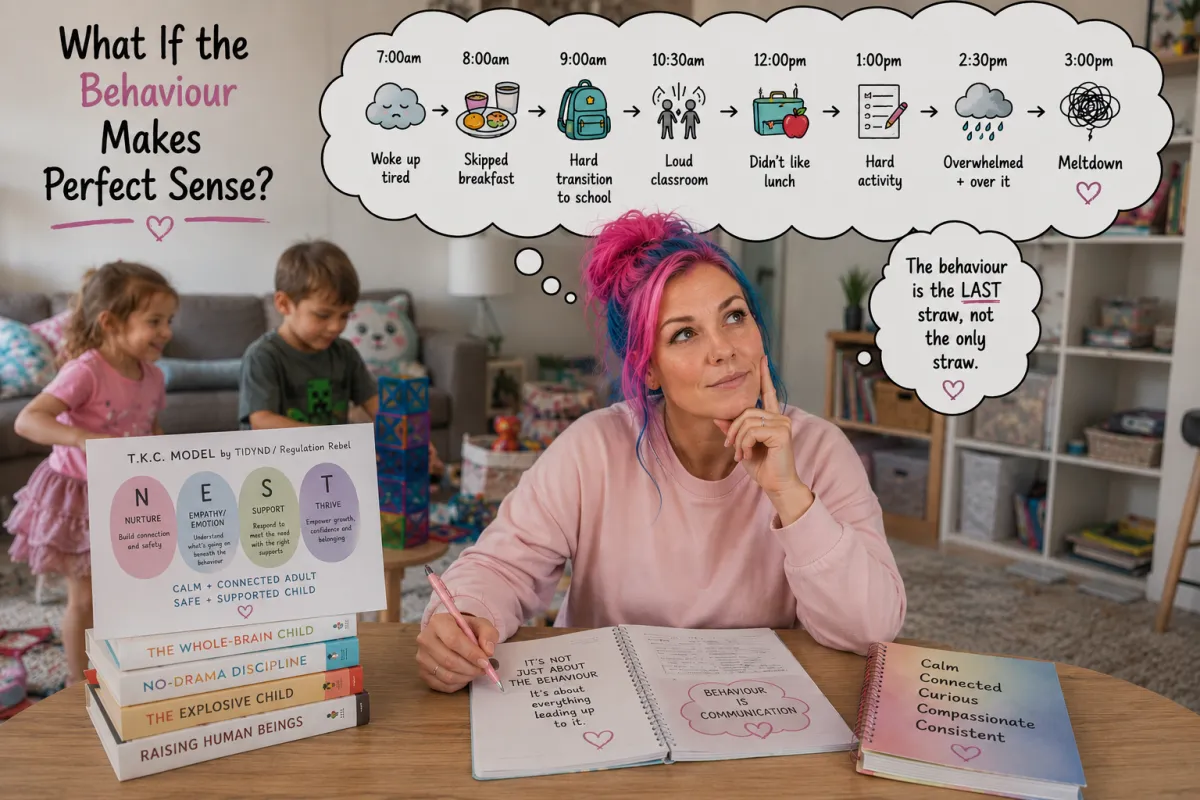
What If the Behaviour Makes Perfect Sense?
What If the Behaviour Makes Perfect Sense?
The Problem
One of the most common things parents say is:
"I just don't understand why they're doing this."
The behaviour seems confusing.
A child refuses to go to school even though they enjoyed it yesterday.
They become upset over something that appears small.
They argue over simple requests.
They shut down when asked a question.
They react in ways that seem bigger than the situation requires.
When behaviour feels confusing, parents often start searching for explanations.
Sometimes they are told the child is being difficult.
Sometimes they are told the child is seeking attention.
Sometimes they are told the child is testing boundaries.
But these explanations often leave parents with more questions than answers.
Because even when they try to address those assumptions, the behaviour frequently continues.
Why It Happens
The challenge is that behaviour only tells us what happened.
It doesn't automatically tell us why.
Imagine watching the final thirty seconds of a movie.
You would see the outcome.
But you would miss everything that happened beforehand.
Behaviour works much the same way.
What we see is often the final visible part of a much longer story.
That story may include:
Anxiety
Sensory overload
Fatigue
Uncertainty
Frustration
Communication difficulties
Social challenges
Executive functioning demands
Skill gaps
Unexpected changes
When we only see the final chapter, the behaviour can seem confusing.
When we understand the story leading up to it, the behaviour often starts to make sense.
What Most People Miss
Many people assume that if a behaviour doesn't make sense to them, it must not make sense at all.
But behaviour doesn't need to make sense from our perspective to have a reason behind it.
A child refusing to enter a classroom may look oppositional.
But if the classroom feels overwhelming, noisy, unpredictable, or unsafe to them, that refusal may be a logical response.
A child who becomes controlling at home may seem inflexible.
But if their day has been filled with uncertainty and demands, seeking control may be their way of creating predictability.
A child who melts down over a broken biscuit may not be upset about the biscuit at all.
The biscuit may simply be the final challenge after a day of holding things together.
When we miss the context, we risk misunderstanding the behaviour.
Maybe it isn't about the lost sock.
The forgotten toy.
The wrong colour plate.
The TKC Perspective
At TKC, we encourage parents to ask a different question.
Not:
"What's wrong with my child?"
But:
"What would need to be true for this behaviour to make sense?"
This question changes everything.
It invites curiosity.
It encourages investigation.
It helps us look beyond the behaviour itself.
Rather than viewing behaviour as random or problematic, we begin searching for patterns.
What happened beforehand?
What environments are involved?
What expectations were present?
What skills were required?
What stressors may have been building?
Often, the more context we uncover, the more understandable the behaviour becomes.
This doesn't mean we approve of every behaviour.
It doesn't mean there should be no limits.
It simply means understanding comes before effective support.
A Practical Example
Imagine a child who regularly becomes distressed before school.
Every morning involves tears, resistance, and frustration.
From the outside, it may appear that they simply don't want to go.
Many attempts are made to motivate them.
Rewards are offered.
Consequences are introduced.
Encouragement is provided.
Yet nothing changes.
Now let's ask a different question:
What would need to be true for this behaviour to make sense?
Perhaps the classroom is extremely noisy.
Perhaps social situations feel overwhelming.
Perhaps transitions are difficult.
Perhaps there are learning demands that feel impossible.
Perhaps the child is anxious about making mistakes.
Suddenly, the behaviour is no longer random.
The behaviour becomes understandable.
And once it becomes understandable, the conversation changes.
Instead of focusing solely on getting the child through the school gate, we can begin exploring the factors making school feel difficult in the first place.
Reflection Questions
The next time behaviour feels confusing, consider asking:
What happened before this behaviour occurred?
What demands were present?
What skills were needed in that moment?
What stressors may have been building?
What would need to be true for this behaviour to make sense?
What pattern am I noticing?
These questions often reveal information that behaviour alone cannot provide.
Summary
Behaviour can look confusing when viewed in isolation.
It can seem random, frustrating, or disproportionate.
But behaviour rarely appears without context.
When we look beyond the behaviour itself and explore the experiences, demands, emotions, and challenges surrounding it, patterns begin to emerge.
From a TKC perspective, one of the most powerful questions we can ask is:
What would need to be true for this behaviour to make sense?
Because behaviour often makes far more sense than it first appears.
And when we understand the context, we move closer to understanding the pattern.
Nobody is the problem.
The pattern is the problem.
Find out more here: The Kid Connection