Maybe What You're Looking For Isn't Better Coping Skills
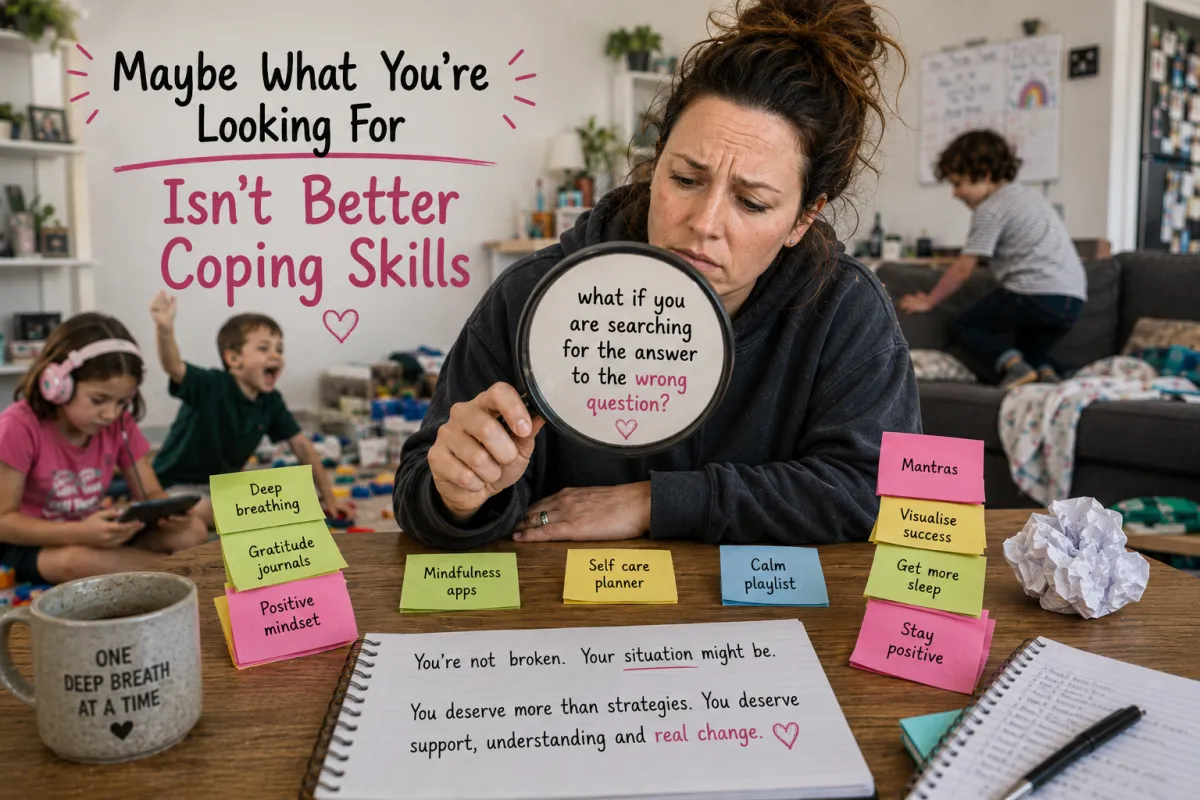
Maybe What You're Looking For Isn't Better Coping Skills
At some point, many of us realise something uncomfortable.
No amount of reassurance ever seems to last.
No amount of certainty feels certain enough.
No amount of preparation completely removes the fear.
No relationship, no matter how loving, can guarantee they will always be available, always understand, always stay the same, or always meet our needs.
And for a nervous system that is constantly searching for safety, that can feel terrifying.
Because underneath the stress, the overthinking, the fixing, the planning, and the hypervigilance is often a deeper question:
Where do I anchor myself when life remains uncertain?
The Search For Certainty
Many parent-carers spend years trying to find a solution. To find the "fix" like it's solvable like a missing puzzle piece. We create safety by becoming better at predicting.
Predicting behaviour.
Predicting emotions.
Predicting needs.
Predicting problems before they happen.
Because certainty feels safe.
If I can see it coming, I can prepare.
If I can prepare, I can cope.
If I can cope, maybe I won't get hurt.
But life keeps reminding us of something difficult:
Certainty is not actually available.
Not completely.
Not permanently.
Children change.
People leave.
Relationships shift.
Needs evolve.
Circumstances turn unexpectedly.
And no amount of effort can remove that reality.
The Search For A Presence That Doesn't Disappear
Sometimes what we call anxiety is not simply fear.
Sometimes it is the nervous system searching for something stable enough to rest against.
Something that remains when circumstances change.
Something that remains when people disappoint us.
Something that remains when life becomes unpredictable.
Because humans naturally seek anchors.
The question is where we find and place them.
Many of us place them in:
our children
our partners
other people's approval
professional success
routines
control
certainty
And eventually we discover that all of those things can move.
Which means the nervous system has to keep working harder and harder to maintain safety.
This Is Bigger Than Coping Skills
The conversation often stops at:
"You need better coping strategies."
And sometimes that's helpful.
Support matters.
Awareness matters.
But there comes a point where the deeper question emerges:
What am I relying on to feel safe?
Because if your nervous system is constantly searching for certainty, abundance, and a presence that never disappears, another human being can never fully provide that.
Not because they don't love you.
Because they're human too.
They have limitations.
They change.
They struggle.
They leave.
They fail.
Just as we all do.
The Shift
The shift isn't always learning how to cope better.
Sometimes it's learning how to anchor differently.
To place your sense of safety somewhere larger than another person's behaviour.
Larger than another person's availability.
Larger than today's circumstances.
Larger than your ability to control outcomes.
Because when safety depends entirely on things outside of us, the nervous system never truly gets to rest.
It stays watchful.
Scanning.
Monitoring.
Preparing.
Waiting.
But when safety becomes anchored in something deeper, something less dependent on changing circumstances, the nervous system no longer has to work so hard to hold everything together.
Maybe That's The Real Question
Not:
"How do I become better at coping?"
But:
"What am I asking coping skills to do that they were never designed to do?"
Because sometimes the answer isn't another strategy.
It's finding an anchor strong enough to hold you when certainty disappears.
And that's a very different journey altogether.
Not sure where to begin?