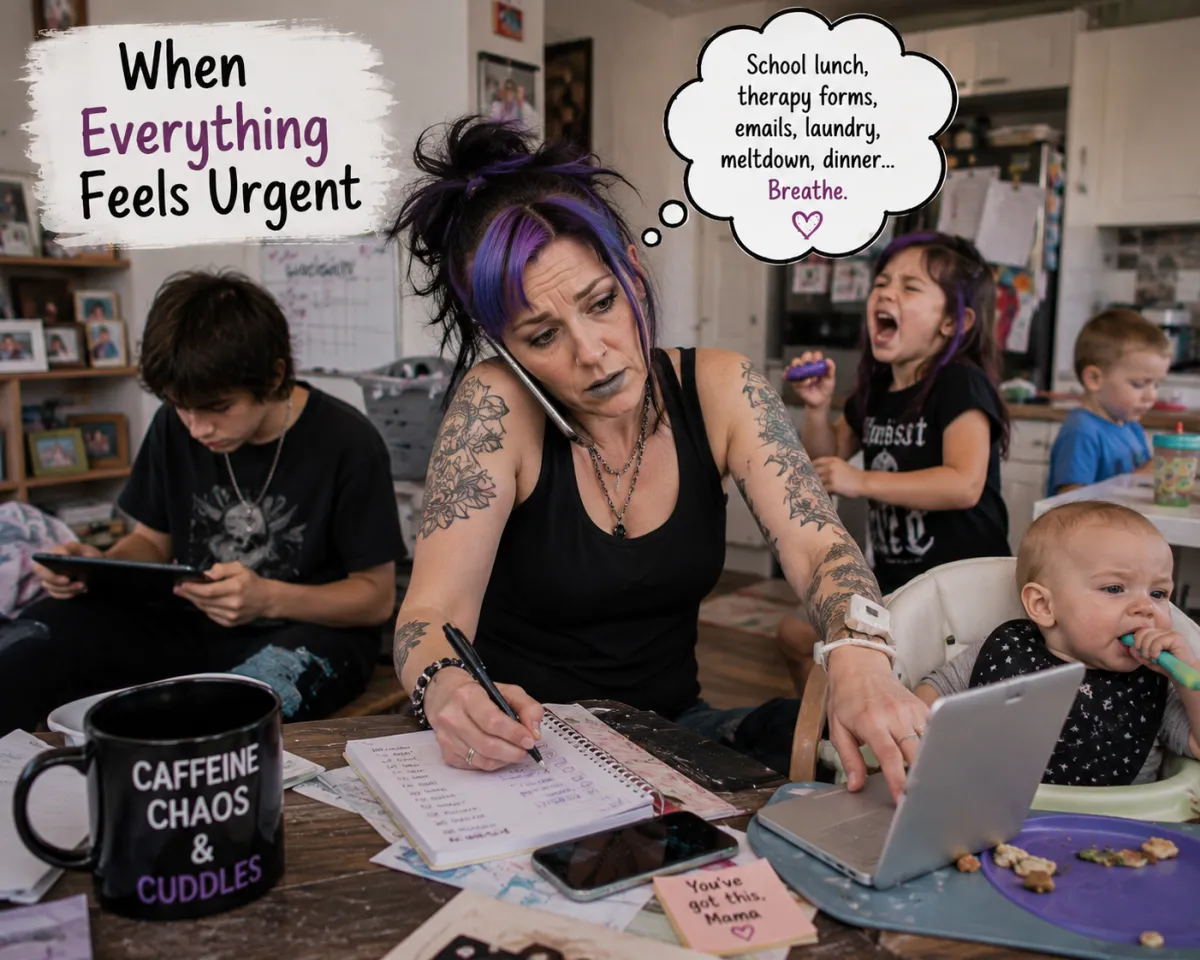
When Everything Feels Urgent
When Everything Feels Urgent
The Problem
Many parents live with a constant feeling that they are behind.
There is always something that needs doing.
A form to complete.
An appointment to organise.
A behaviour concern to think about.
A message to answer.
A household task waiting in the background.
For parents carrying the mental load of a family, it can feel like life has become one long list of unfinished responsibilities.
The result is often a persistent sense of urgency.
Everything feels important.
Everything feels immediate.
Everything feels like it should have been done yesterday.
Over time, this can leave parents exhausted, overwhelmed, and unsure where to focus their energy.
Why It Happens
When we think about urgency, we often assume it's caused by the number of tasks we have.
Sometimes that's true.
But many parents discover that even when they cross things off the list, the feeling of urgency remains.
That's because urgency is not always about workload.
It's often about cognitive load.
Cognitive load refers to the amount of information, decisions, possibilities, and responsibilities your brain is trying to manage at once.
Parents are rarely carrying just tasks.
They're carrying questions.
Should I follow up with the teacher?
Is my child coping at school?
Do I need another assessment?
Am I being too strict?
Am I being too flexible?
What happens if I get this wrong?
These unanswered questions take up mental space.
The brain continues holding them open, often treating them as unfinished business.
The more open loops we carry, the more urgent life begins to feel.
What Most People Miss
When parents feel overwhelmed, advice often focuses on productivity.
Create a better schedule.
Use a planner.
Set reminders.
Get organised.
While these strategies can help, they don't always address the deeper issue.
The challenge isn't necessarily poor organisation.
The challenge is that everything has started competing for the same level of importance.
A forgotten library book can feel just as urgent as a child who is struggling emotionally.
A pile of washing can feel just as pressing as a difficult conversation that needs to happen.
When everything is placed in the same mental category, the brain has no clear system for deciding where attention should go first.
This creates decision fatigue.
And decision fatigue creates overwhelm.
The TKC Perspective
At TKC, we often talk about moving from endless possibilities to understanding.
When everything feels urgent, parents are often trying to hold too many possibilities at once.
Every task matters.
Every concern matters.
Every decision feels significant.
The goal isn't to ignore responsibilities.
The goal is to create clarity.
Clarity allows us to separate:
Urgent from important
Immediate from eventual
Actionable from uncertain
Today's problem from tomorrow's problem
This doesn't remove responsibilities.
It simply gives them somewhere to sit.
When responsibilities have structure, the nervous system no longer has to hold everything at maximum alert.
That's where overwhelm begins to reduce.
A Practical Example
Imagine a parent named Sarah.
It's Tuesday afternoon.
Her child has had a difficult morning at school.
There's washing waiting to be folded.
An occupational therapy report needs reading.
Dinner hasn't been planned.
A sibling argument is escalating.
An email from school has just arrived.
Sarah feels overwhelmed.
Everything feels urgent.
Without clarity, she may jump rapidly between tasks.
She starts reading the email.
Then remembers dinner.
Then checks the report.
Then breaks up an argument.
Then worries about school.
Replies to the email, because she knows if she doesn't do it now -
It will get forgotten in the future to do list.
At the end of the hour, she feels somewhat completed, still busy but no calmer.
Now imagine Sarah pauses and asks:
What needs my attention right now?
The answer might be the sibling conflict happening in front of her.
Everything else remains important.
But it is not equally urgent.
By identifying one priority, Sarah can respond intentionally rather than reactively.
Once that situation settles, she can choose the next thing.
One step at a time.
The workload hasn't changed.
But the experience of carrying it has.
Reflection Questions
If everything feels urgent right now, consider:
What is actually happening in this moment?
What feels urgent but could reasonably wait?
What concern am I carrying that doesn't require an immediate decision?
Which task would create the most relief if completed first?
Am I responding to importance or reacting to pressure?
Can I prioritise one task to do this hour, and one to do in the following hour?
These questions can help create the separation needed for clearer thinking.
Summary
When everything feels urgent, it is easy to assume the solution is doing more.
Often, the more helpful solution is seeing more clearly.
Parents carry an enormous number of responsibilities, decisions, and concerns every day.
When all of those responsibilities compete for attention at the same time, overwhelm is a natural outcome.
The answer is not perfection.
The answer is clarity.
Not every problem needs solving today.
Not every task needs immediate action.
Not every concern requires a decision right now.
When we begin separating what truly needs attention from what simply feels urgent, we create space to think, respond, and parent with greater confidence.
Because clarity doesn't remove the load.
But it does make it far easier to carry.
Find out more here: The Kid Connection