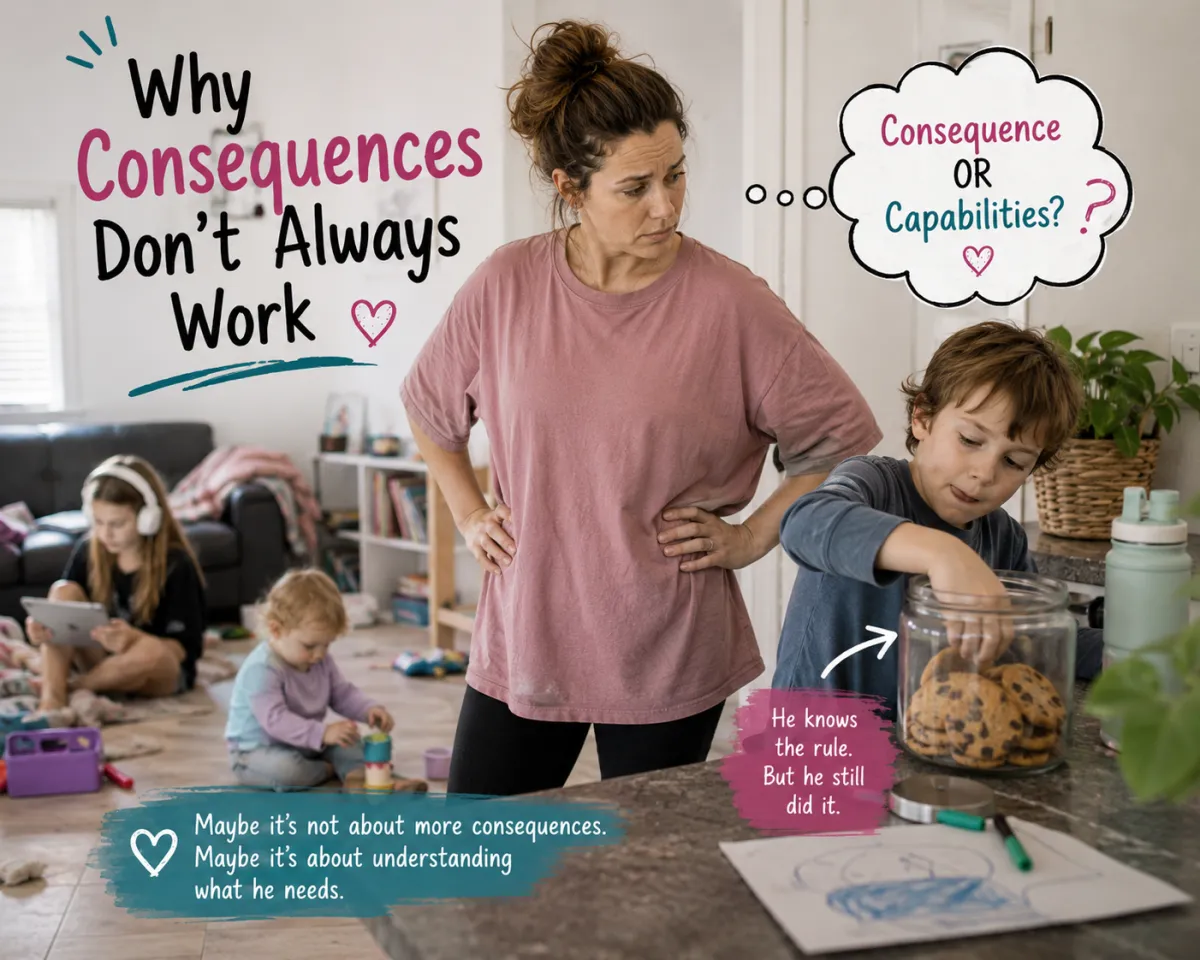
Why Consequences Don't Always Work
Why Consequences Don't Always Work
For generations, consequences have been one of the most common tools in parenting.
The idea seems straightforward:
A behaviour happens.
A consequence follows.
The child learns from the outcome.
The behaviour improves.
Sometimes this works exactly as expected.
But many parents discover something confusing.
The consequence happens.
The child experiences it.
And then the behaviour happens again.
Nothing changes.
Or worse, the struggle becomes bigger.
This often leaves parents wondering:
Am I being too soft?
Am I being inconsistent?
Do I need stronger consequences?
Why isn't this working?
The answer is often simpler than it appears.
Consequences don't always work because not every behaviour is a motivation problem.
The Assumption Behind Consequences
Consequences are built on a particular assumption.
They assume the child has the ability to behave differently and simply needs additional motivation to do so.
This works reasonably well when the issue truly is about choice and motivation.
For example, forgetting to put away a bike might improve if there is a predictable consequence attached.
But many parenting challenges involve something more complex.
The child may not be struggling because they don't want to succeed.
They may be struggling because something is getting in the way.
When Behaviour Is About Capacity
Think about situations where children are:
Overwhelmed
Anxious
Dysregulated
Sensory overloaded
Exhausted
Struggling with transitions
Lacking a specific skill
Having difficulty communicating
In these moments, behaviour is often reflecting a challenge rather than a lack of motivation.
Imagine asking someone to run a race with a broken leg.
A consequence for not finishing the race doesn't solve the injury.
The barrier remains.
The same principle often applies to behaviour.
If the difficulty sits in capacity, increasing consequences rarely removes the barrier.
What Most People Miss
When consequences fail, many people assume the consequence isn't strong enough.
This often creates an escalation cycle.
The behaviour continues.
The consequence gets bigger.
The behaviour continues again.
The consequence becomes stricter.
Everyone becomes more frustrated.
Yet the original challenge remains untouched.
The problem wasn't necessarily the size of the consequence.
The problem was that the consequence wasn't addressing the reason the behaviour was happening.
The TKC Perspective
At TKC, we encourage parents to look beneath behaviour before deciding how to respond.
Instead of asking:
"How do I stop this?"
We ask:
"What's making this difficult?"
This question changes where we focus our energy.
Rather than increasing pressure, we start looking for information.
What skills might be missing?
What needs are present?
What environmental factors are contributing?
What patterns are repeating?
Because when behaviour keeps happening despite consequences, that's often a clue.
The behaviour may be communicating something important.
A Practical Example
Let's imagine a child who has a meltdown every afternoon after school.
The family introduces consequences for shouting.
The shouting continues.
More consequences are added.
The pattern remains.
Looking deeper reveals something interesting.
The child has spent six hours managing social demands, sensory input, transitions, expectations, and constant effort.
By the time they arrive home, they are running on empty.
The meltdown isn't occurring because they don't care about the consequences.
It's occurring because they have reached the limit of their capacity.
Once the family understands the pattern, their response changes.
Instead of focusing solely on consequences, they begin creating recovery time after school.
Demands are reduced temporarily.
Support is increased.
The behaviour gradually improves.
Not because the consequence became stronger.
Because the underlying challenge was recognised.
Consequences Can Still Have a Place
Understanding behaviour does not mean removing all limits, expectations, or accountability.
Consequences can still be useful.
Children need boundaries.
They need guidance.
They need opportunities to learn how their actions affect others.
But consequences are often most effective when they are paired with understanding.
If a child lacks a skill, they may need teaching.
If a child is overwhelmed, they may need support.
If a child is anxious, they may need help feeling safe enough to engage.
Without addressing those factors, consequences alone may have limited impact.
Reflection Questions
When a consequence doesn't seem to be working, consider:
Does my child already know what is expected?
Do they have the skills needed to meet that expectation?
What happens before the behaviour?
Is there a pattern?
Could anxiety, overwhelm, fatigue, sensory input, or another challenge be contributing?
What support might be needed alongside accountability?
These questions often reveal important information.
These should be asked before consequences are implemented on a heavier scale.
Summary
Consequences can be helpful tools.
But they are not solutions for every behaviour.
When a child already has the skills and capacity to do something differently, consequences may influence behaviour.
When a child is struggling because of overwhelm, anxiety, sensory challenges, emotional regulation difficulties, or lagging skills, consequences often have much less power.
This is why bigger consequences don't always create better outcomes.
The key question isn't always:
"What consequence should follow?"
Sometimes the more useful question is:
"What is making this difficult?"
Because lasting change usually comes from understanding the pattern underneath the behaviour.
Nobody is the problem.
The pattern is the problem.