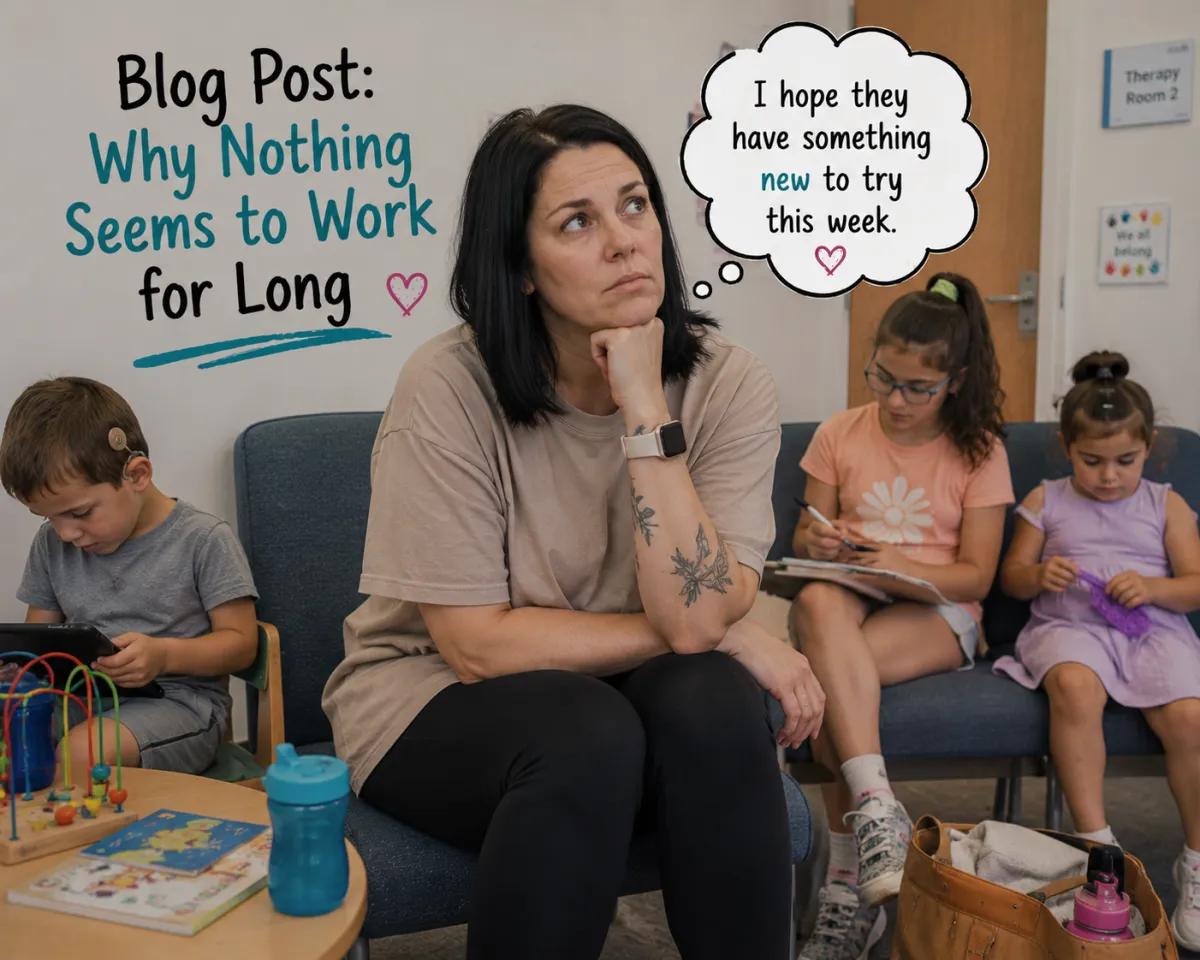
Why Nothing Seems to Work for Long
Why Nothing Seems to Work for Long
There is a particular kind of frustration many parents know well.
You find a strategy.
You implement it consistently.
Things improve.
You start to feel hopeful.
And then, weeks or months later, the challenge returns.
The behaviour reappears.
The conflict resurfaces.
The struggle comes back.
And the question follows:
"Why does nothing seem to work for long?"
It's a question that can leave parents feeling exhausted and discouraged.
Because if every solution stops working eventually, what's the point of trying?
But what if that's not actually what's happening?
What if the issue isn't that nothing works?
What if it's that parenting challenges are rarely as simple as they first appear?
The Myth of the Permanent Fix
Many of us are taught to think about problems as things that can be solved once and then disappear.
A leaking tap gets repaired.
A broken appliance gets replaced.
A flat tyre gets fixed.
Parenting doesn't usually work that way.
Children are constantly developing.
Their needs change.
Their environments change.
The expectations placed upon them change.
What works at one point in time may need adjustment later.
Not because it failed.
Because the situation evolved.
Why Improvement Doesn't Always Last Forever
When a strategy helps, it often addresses a specific part of a challenge.
For example:
A visual schedule may support transitions.
A sensory adjustment may reduce overwhelm.
A communication tool may reduce frustration.
A routine may create predictability.
These supports can be incredibly valuable.
But they don't stop life from changing.
As children grow, new demands emerge.
School expectations increase.
Social relationships become more complex.
Independence expands.
New situations appear.
The pattern may shift because the context has shifted.
What Most People Miss
When a challenge returns, many parents assume they are back at the beginning.
This can make previous progress feel meaningless.
But progress isn't erased simply because a struggle reappears.
Imagine a child learning to ride a bike.
Falling off occasionally doesn't mean they never learned.
It means learning is still underway.
The same is true for many behavioural and emotional challenges.
Growth often includes setbacks, fluctuations, and periods of adjustment.
These experiences are part of the process, not proof that the process failed.
The TKC Perspective
At TKC, we view behaviour through the lens of patterns rather than quick fixes.
A strategy is not successful because it eliminates every future challenge.
A strategy is successful when it helps us better understand or support the child.
Sometimes that support reduces a behaviour.
Sometimes it teaches a skill.
Sometimes it uncovers information we didn't previously have.
All of these outcomes matter.
Because understanding is often more valuable than any temporary compliance.
Understanding spans beyond the right now.
Beyond todays struggle.
Beyond future struggles.
A Practical Example
Imagine a child who struggles every morning before school.
The family introduces a visual routine.
The mornings improve dramatically.
For several months, everything seems easier.
Then difficulties return.
The immediate conclusion might be:
"The visual routine stopped working."
But a closer look reveals something different.
The child has started new difficult friendships.
Expectations have increased.
The workload is slightly heavier.
Social demands have changed.
The visual routine is still helping.
It simply isn't addressing the newest challenge.
The original support wasn't ineffective.
The situation became more complex.
This distinction matters because it changes what happens next.
Instead of abandoning the support, the family builds on it.
They begin exploring the new demands affecting the child.
Looking for Progress Instead of Perfection
One reason parents become discouraged is that they often measure success by whether a challenge disappears completely.
But meaningful progress can look like:
Faster recovery after difficult moments
Improved communication
Greater self-awareness
Increased flexibility
Reduced intensity
More successful attempts
Better coping skills
These gains remain important even if the original challenge occasionally returns.
Growth is often gradual and uneven.
Reflection Questions
When you feel like nothing is working for long, consider:
What improved while the strategy was in place?
What changed in the environment?
What new demands have appeared?
What skills has my child developed?
What challenges are emerging now?
What information have I gained about the pattern?
These questions can reveal progress that is easy to overlook.
Summary
When parenting strategies stop producing the same results, it's tempting to assume they failed.
But often the reality is more nuanced.
Children grow.
Circumstances change.
New challenges emerge.
A strategy may solve one part of the puzzle while another part is still developing.
That doesn't make the strategy worthless.
It means parenting is an ongoing process of understanding, adapting, and responding.
The goal isn't to find a solution that works forever.
The goal is to keep learning about the child in front of you.
Because lasting change rarely comes from a single perfect strategy.
It comes from understanding the pattern well enough to adapt as life changes.
Nobody is the problem.
The pattern is the problem.